

Building Design 101
We’re talking about what makes a building Orthodox.
And, at the conclusion of our last post, we were working through an issue that confronts a lot of new communities—when you don’t yet have a permanent home, or when you’re not yet able to afford the facility you really want to build, how can you let folks know that you are an Orthodox parish?
In other words, what’s the best way to communicate the unique nature of The Faith?
Many communities try to do that architecturally, and that often involves something that sort of looks like a dome, but there is a better way to approach all this.
At the end of each and every one of our posts, we ask for your prayers, and we even provide you with a link to a service called the Akathist for a New Temple (PDF/video). If you have been offering that service along with us, then you know that Oikos 7 of that Akathist reads like this
In the account of thy martyrdom, O holy Justin, when Rusticus the Prefect asked where the Christians in Rome assembled, thou didst reply that they gathered at the Timiotian Bath. But now that thy relics abide in our holy altar, thou dost also join in our assembly, as together, across the centuries, we call out: Alleluia!
St Justin the Philosopher was martyred in Rome in the year 165.
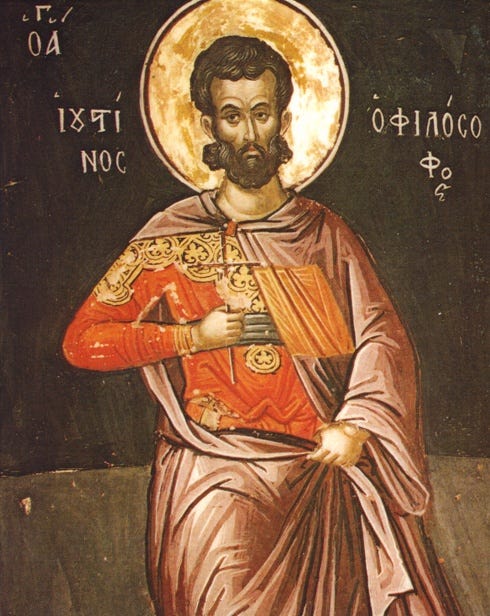
And, yes, we do have his relics in our Holy Table.


But the part of the Akathist that we want you to note today is the part where St Justin tells the judge that the Christian community he belonged to in Rome met at the Timiotian Bath.
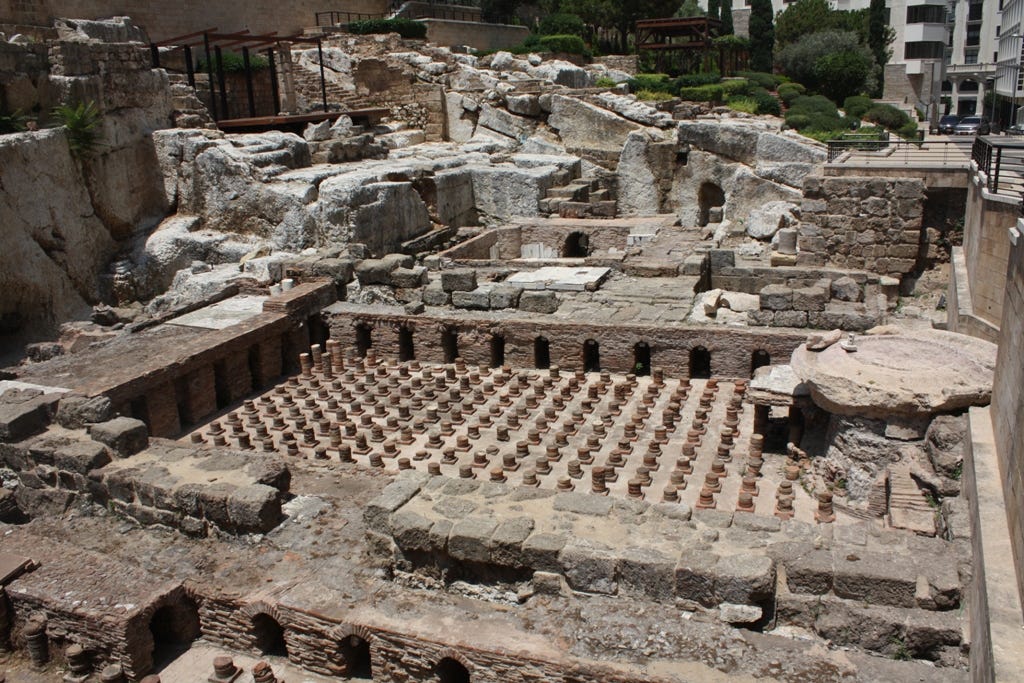
There were a lot of public bathing facilities in the City of Rome, and the Timiotian was an especially large complex. We do not know exactly where St Justin gathered with his sisters and brothers—it might have been in one of the facilities’ big open spaces; it might have been in a private room.
However, if you are currently part of an Orthodox group that is still looking for permanent location, it should be encouraging to know that one of the great saints of the Church worshipped with a group that met in the second century equivalent of a Gold’s Gym.
And it should also be instructive that St Justin and his community were able to communicate the unique nature of The Faith directly and personally, through their own lives.
In fact, it was not until many years later that the Church was able to express the beauty of Holy Orthodoxy architecturally. We’ve written about how Christians took full advantage of that opportunity when it did become available, but prior to the late fourth century, folks like St Justin and his sisters and brothers witnessed to the Faith by simply being patient and kind and generous and merciful.
And those qualities—those virtues—are going to make a bigger impact on folks than any kind of attempt to put together a DIY dome.
Because, truth be told, a mail-order cupola or a repurposed grain storage cap could very well just end up confusing people.
But goodness and hope and joy are pretty straightforward.
And speaking of straightforward, that’s a really good description of the plan for an Orthodox temple that we talked about it our last post. Remember? It’s called the Simple Gable Design
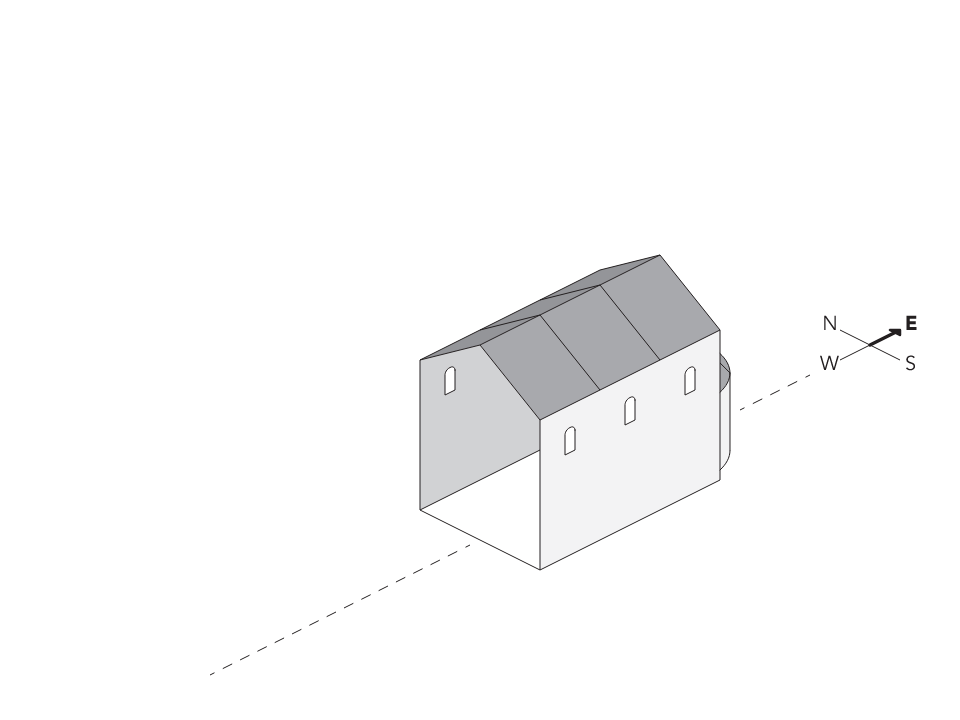
This layout features a symmetrical building that faces east. The structure is higher than it is wide; it faces east; it is illumined with light that comes through windows.
There is nothing elaborate or exotic about the Simple Gable Design, but, for centuries now, it is the basic way that Orthodox temples have been put together.
And when the Divine Services are offered in that kind of simple setting, it generates a deep-down kind of dignity, the kind of dignity that comes from knowing who you are and To Whom you belong, the kind of dignity that is the necessary foundation for virtues like gentleness and peace and love.
That’s something we’ve learned from our own experience, because the building in which we currently worship is just a large version of the Simple Gable Design.


Eventually, that structure will become our Fellowship Hall, but, for over fifteen years now, that layout has not only served us well, it has also connected us with our sisters and brothers in the Faith all around the world and down through the centuries who are using or have used the same basic model.
But what happens when that model can no longer accommodate all the people in our community?
We are already at that point and have been for several years.
And it just won’t work to try and build another structure using the Simple Gable Design. As we’ve demonstrated, the model is attractive, and it has a great many advantages, but it cannot be expanded beyond a certain point—because, after a while, with the height of the structure and its forward-facing orientation, it just becomes a tunnel.
But the lived experience of the Church provides us with a number of other good options.
We’ll look at one of those options in our next post. But before that post posts, please join us in offering the Akathist for a New Temple (PDF/video). If you budget will allow it, please become a Paid Subscriber, purchase a Come See Something Beautiful T-shirt, commission an image of a beloved animal for the Calming Room or our new temple or make a direct donation to our Building Fund.
And we’ll keep that construction theme going with The Great Gospel Men.