

Greener than Oz, Part III
In this “Greener than Oz” series of articles, we’ve been talking about the fact that we humans are the High Priests of Creation. Our main high priestly job is leading all the creatures of this world in praise of the Most Holy Trinity, but it’s really easy to overlook some of those creatures.
For example, in our last post, we talked about light. Most of us don’t even regard light as a creature, but, in this article, we’re going to go a step further and focus on darkness.
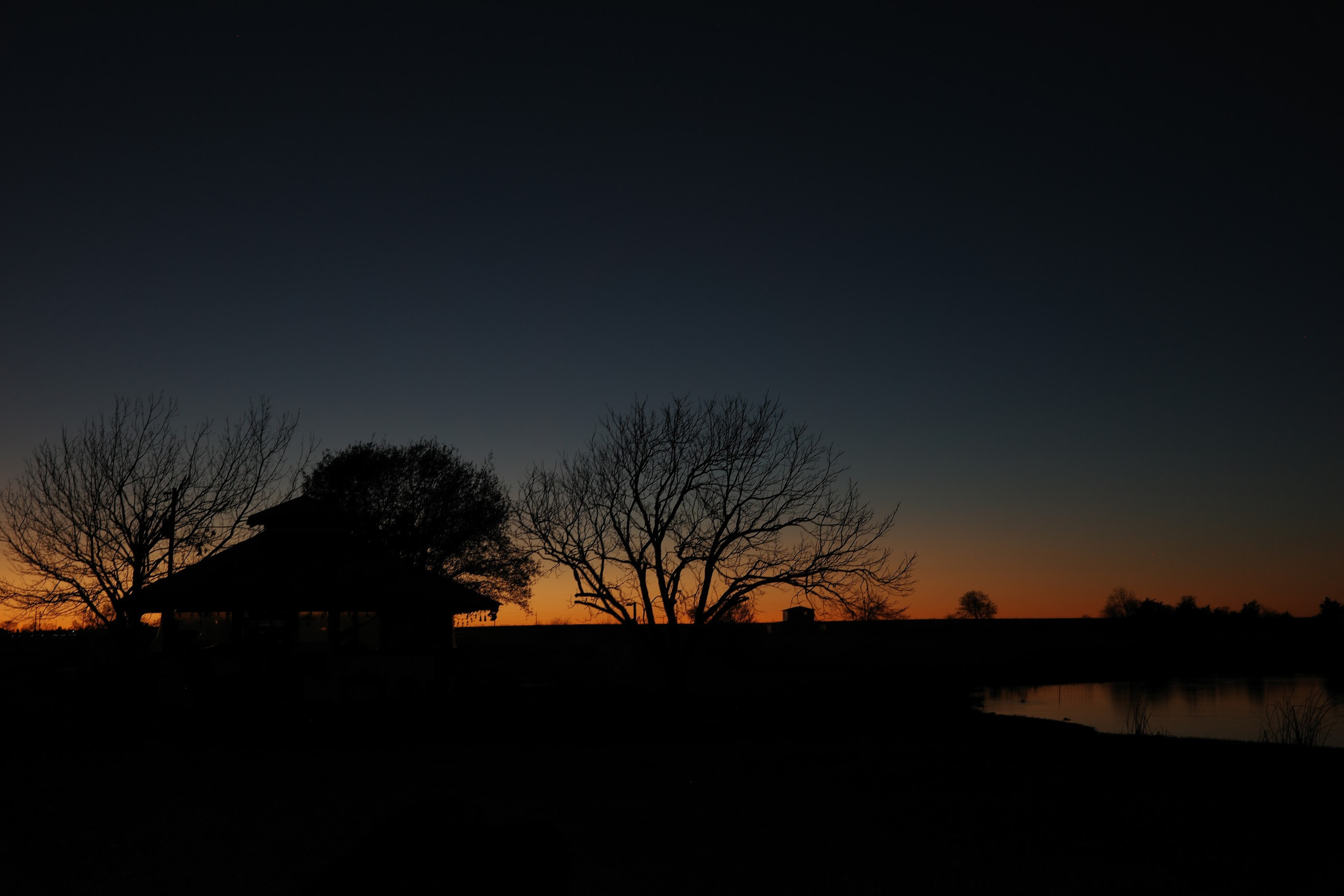
That’s right. Darkness.
In fact, you could make a good case that darkness is really the very first creature because before the Father, Son, and Holy Spirit call forth light, we are told that “darkness was upon the face of the deep” (Genesis 1.2). And you get that same sense from these lines in the Book of Job:
Where is the way to the dwelling of light,
and where is the place of darkness,
that you may take it to its territory
And that you may discern the paths to its home? (38.19-20)
Darkness even seems to have a special connection to the very presence of the Most Holy Trinity. In Psalm 17, we sing
And He bowed the heavens and came down,
And thick darkness was under His feet.
And He mounted upon cherubim and flew,
He flew upon the wings of the winds.
And He made darkness His hiding place,
His tabernacle round about Him,
Dark waters in the clouds of the air. (vv9-11)
Many of the Holy Fathers regard our perception of or our entrance into that darkness as an image of our union with the Father, Son, and Holy Spirit. St Gregory of Nyssa is especially good at describing that dynamic; here’s how he puts it in his Homilies on the Song of Songs:
The soul that has made its way through these stages to high things, having left behind whatever is accessible to human nature, enters within the innermost shrine of the knowledge of God and is entirely seized by the divine darkness. (Norris, 339-341)
And, sure, that “divine darkness” is a profound spiritual reality, but Holy Scripture and the Holy Fathers make a clear connection between that reality and the everyday darkness that we sing about at the beginning of each and every Liturgical Day
Thou appointedst the darkness, and there was the night (103.20).
So, darkness should also have a place in our temples.
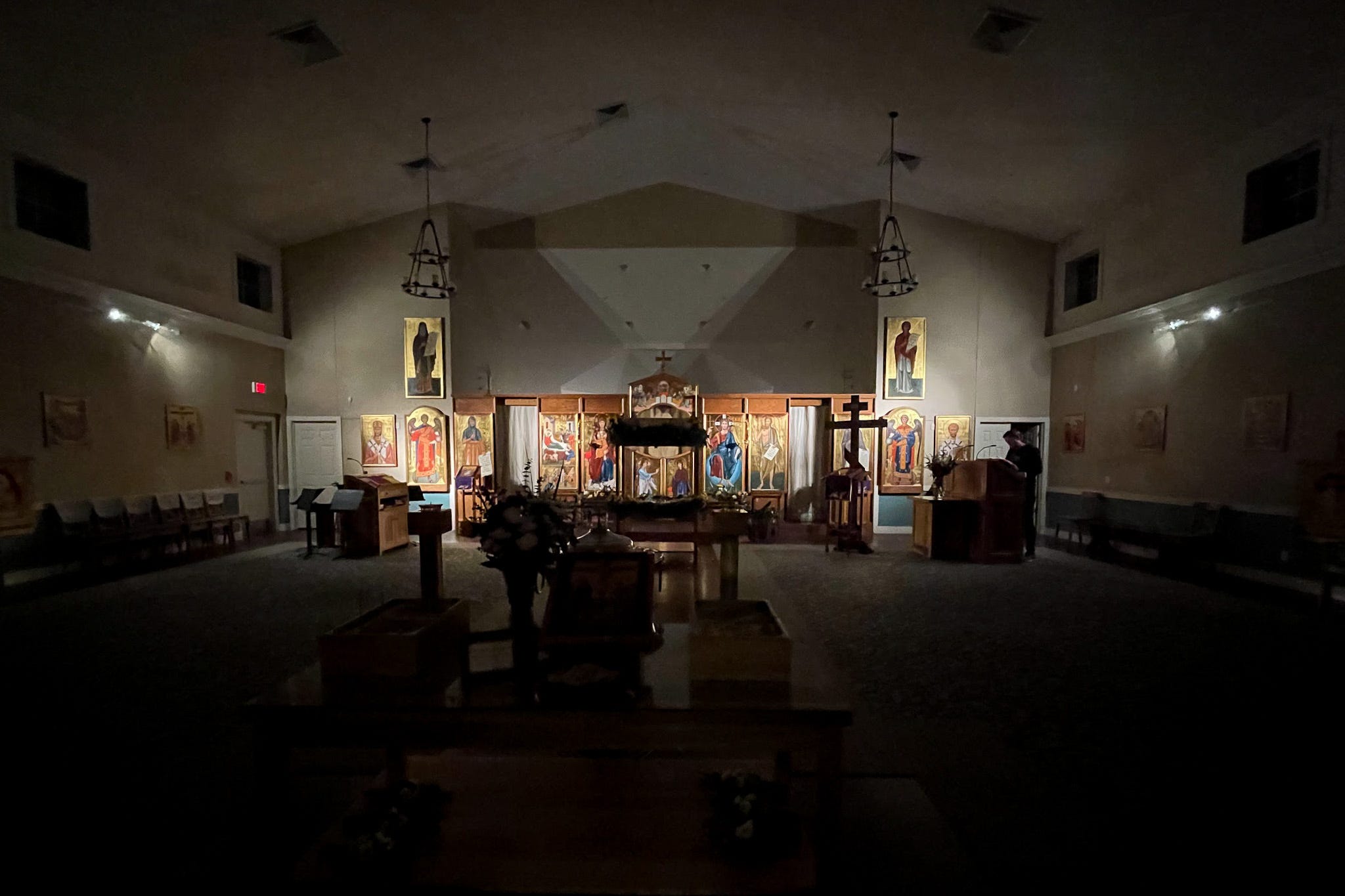
And, if my personal experience is any indication, we Orthodox do a pretty good job of this when it comes to evening services. That’s because, when we’re serving Vespers or Compline, we dim the lights and fire up the candles and allow the shadows to form and shift and play. But, in most communities, when Sunday morning rolls around, boy, oh, boy, our temples are lit up like the Griswold’s at Christmas
And, yeah, OK, that comparison may be a bit much, but there’s no doubt about the fact that, when it comes to the place that darkness has in our services, the average Orthodox Sunday morning can produce some really ironic moments. For example, during Orthros, the service that precedes the Divine Liturgy, the priest reads prayers that include these lines:
Be mindful, O Lord, of those who cry aloud unto Thee in the night…
O Lord our God, who hast banished from us the sluggishness of sleep and hast called us together by a holy bidding, that in the night also we may lift up our hands…
But, at least in most parishes in North America, those “night” prayers are offered just about the same time most secular folks are mowing their lawns or playing frisbee golf or sitting down to brunch.
Nevertheless, since it’s just not practical to offer the Divine Services according to the (largely monastic) way in which they were originally scheduled, that’s even more reason to actually design structures that allow for the presence of some darkness—even when it’s the middle of the day. Thus, instead of adapting the big, open auditorium model—which generally involves just hanging some icons along the walls of the ‘box’—we could go back to building temples that include side aisles and arches and transepts and pillars and corners.
Our fore-parents used those architectural features because they did not have construction materials that would allow them to safely and cheaply build structures that featured big, broad spaces. We can do that now, but just because we can put up that kind of building doesn’t mean we should—especially when the building we’re erecting is an Orthodox temple.
Because an Orthodox temple is for all of the creatures of the Most Holy Trinity, and darkness is also one of those “very good” creatures (Genesis 1.3). And our interaction with the Father, Son, and Holy Spirit will be that much richer if it includes a shadow under an arch or the shade cast by a pillar or a corner that’s just a bit darker than the rest of the nave.
And to give you a sense of just how much darkness is out there, here’s ten hours of night on video.
Doesn’t all that dark deserve a place in our worship? That great and beautiful creature might even give us the opportunity to enter the “hiding place” of which the Holy Prophet David sings and the “innermost shrine” described by St Gregory.
If that’s the kind of project you’d like to support financially—or participate in directly—just get in touch with us. Donate here: Give now.