

Greener than Oz, Part V
Then shall all the trees of the forest rejoice at the presence of the Lord, for He cometh, for He cometh to judge the earth
-Psalm 97.12-13
We’re still talking about how Holy Orthodoxy, in general, and our parish community, in particular, are “Greener than Oz”.
What that means, on a practical level, is that, as High Priests of this Creation, we humans are called to lead all the creatures of the natural world in the worship of the Most Holy Trinity—and, as you have, no doubt, already guessed based on those lovely verses from Psalm 97, today we’re going to focus on how that dynamic works in our relationship with trees.
That’s an easy connection to trace, because our Holy Table, the altar upon which we consecrate the Holy Eucharist is made of local, Texas wood. Baker Galloway and Martin Earle designed the altar, using ancient models, and the piece was built by an Austin wood-worker, Adrienne Romine.


Martin Earle carved the frontlet for the Holy Table. The wood he used for that polychromed icon is English oak. Of course, the Holy Eucharist is central to the life of our parish community, so it’s not at all a stretch to point out that the lovely verses which open this post are actually prophetic, and to add that the prophecy is fulfilled in the wood that has been used in our Holy Table.
But at St John the Forerunner, the relationship we have with trees also extends beyond our temple. For example, right next to our fellowship hall is a large live oak. Our arborist tells us that this particular tree is almost one hundred years old, and, like a great many live oaks, it has long branches that hang low to the ground.


All the children of our parish (and not a few grown-ups) have explored those branches (sometimes to some pretty impressive heights). Since live oaks keep their leaves most of the year, this tree also provides us with shade (which, in Texas, is a genuine blessing). So, on most Sundays throughout the year, this tree is an integral part of what we Orthodox call Fellowship Hour.
Fellowship Hour works differently in different communities, but in our parish, it is the meal that we share after the Divine Liturgy. In Holy Orthodoxy, we fast prior to receiving the Holy Eucharist, so when the liturgy has ended, everyone is hungry (and un-caffeinated). But we pick up some food and some coffee in the kitchen and then we head outside and sit together at picnic tables under this tree, and others like it
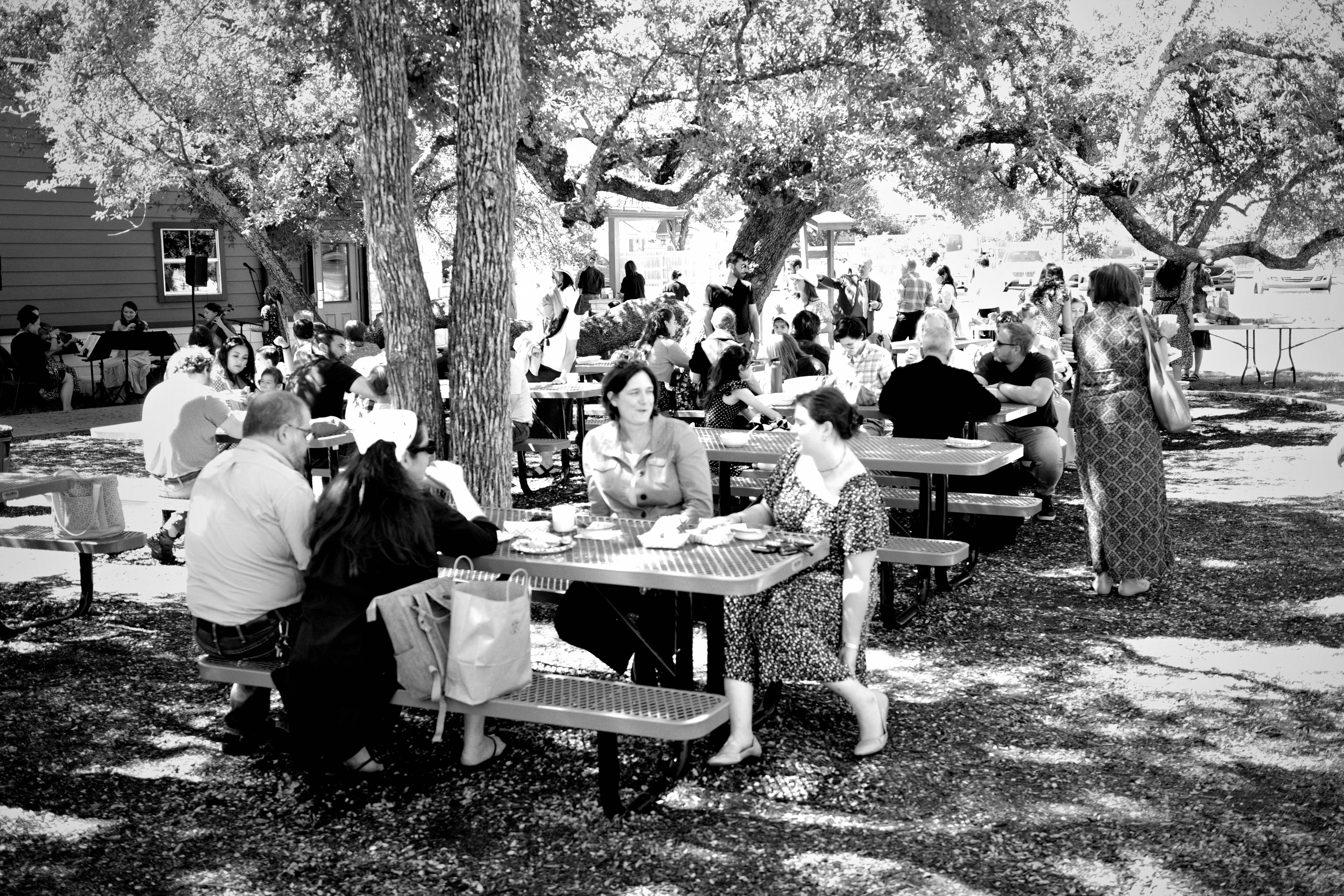
It’s a big part of what liturgical scholars like to call “the liturgy after the liturgy”: we share a sacred meal during the worship service, and then that meal continues during Fellowship Hour. And the trees are not only present through it all, these creatures participate in it all.
But, as powerful as all that is, the main connection between trees and our worship of the Father, Son, and Holy Spirit, is what we in Holy Orthodoxy call The Tree of our Redemption—the Precious and Life-Giving Cross. This being the internet, there are most likely still some folks out there who have bought into the old line about how we Orthodox emphasize the Resurrection as opposed to the Cross. If you already know how ridiculous that is, feel free to skip the next paragraph; if you regard that tired old observation as wisdom, read on.
In Holy Orthodoxy, we celebrate three major feasts of the Cross during the course of each Liturgical Year: The Veneration of the Cross on the Third Sunday of Great Lent; the Procession of the Cross on August 1, and the Elevation of the Cross on September 14. In addition to those feast days, the services for each and every Wednesday and Friday of the year—yes, each and every Wednesday and Friday—focus on the Cross. Every baptized Orthodox Christian wears a small cross underneath their clothing, and Orthodox Christians frequently make the Sign of the Cross to express their reliance on the grace of the Most Holy Trinity.
So, yeah, in Holy Orthodoxy, the Cross is a Big Deal.
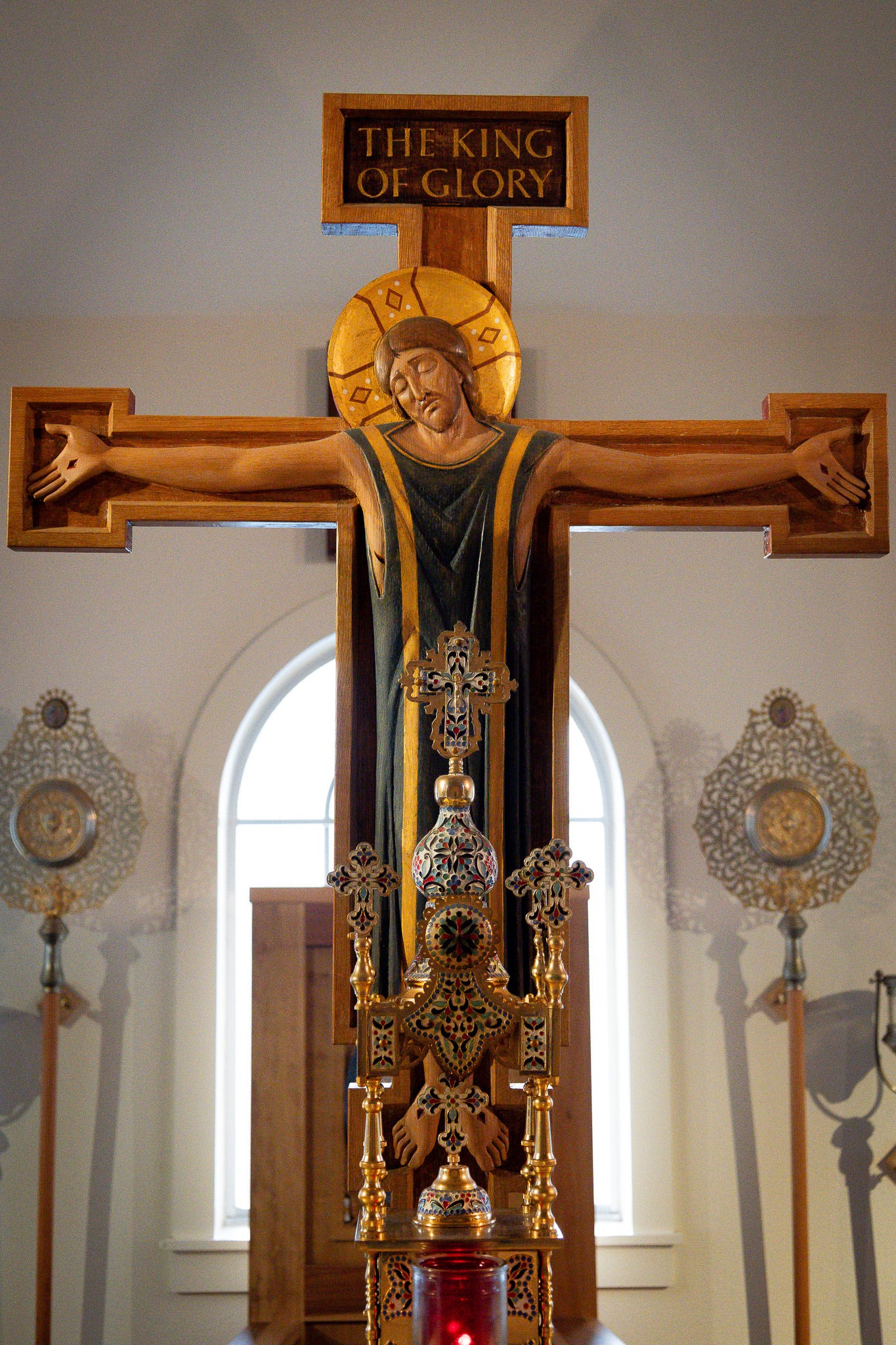
The cross that is located behind our Holy Table is a genuine work of art. The icon was carved and polychromed by Martin Earle; the wood he used is English oak, and that wood now conveys the love that our Lord and Master offers on our behalf to God the Father through the power of the Holy Spirit.
And that entire dynamic is beautifully summed up for us in a hymn that we sing on the Feast of the Elevation:
“Let all the trees of the wood rejoice, for their nature is made holy by Christ, Who planted them in the beginning and Who was outstretched on the Tree. At its Elevation, on this day, we worship and thee do we magnify.” (Mother Mary and Kallistos Ware, p 151)
On Great and Holy Thursday, during the Service of The Twelve Holy Gospels, we process through the temple with the Precious and Life-Giving Cross, and, as we set it up in the center of the nave, we sing this hymn:
In Holy Orthodoxy, then, the Cross is the most powerful symbol of how all the trees take part, not only in our worship of the Father, Son, and Holy Spirit, but in the redemption that is brought about by the Most Holy Trinity.
If you believe that kind of relationship is worth supporting, if you would like to help us build a temple that will deepen that relationship, just follow this link and know that we are grateful for your help: Give Now.
Minor Correction: I believe the polychromed frontal of the altar was actually carved in North American white oak - likely from Michigan. Adrienne fashioned the solid panel as a removable insert when she built the altar table. The panel was then transported to Martin for carving and polychroming, after which it was returned and inserted into the altar table. 🤓