

Interviewing the Iconographers: Baker Galloway
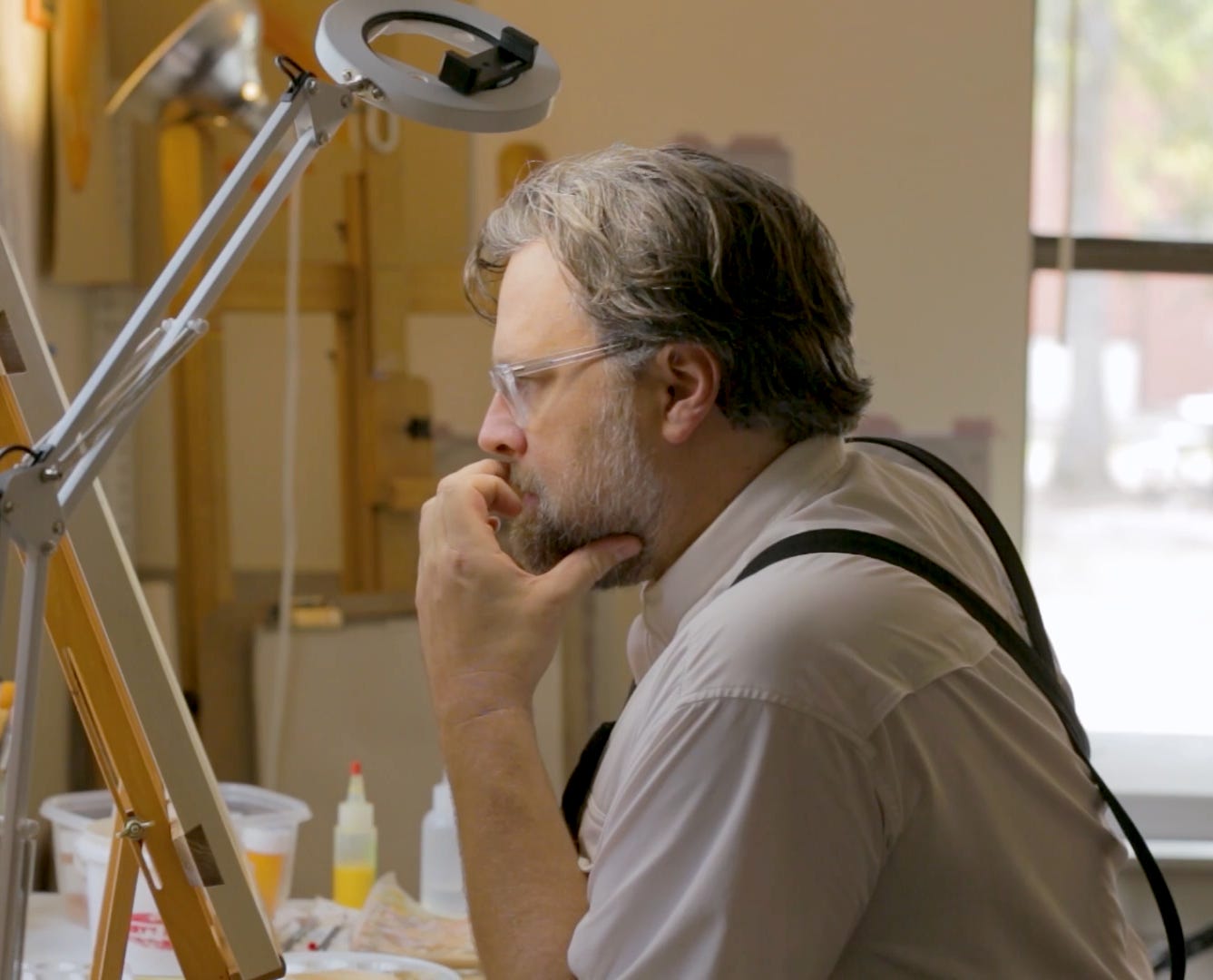
This is the first installment in a series of interviews with the three iconographers who will work together on the iconographic program for our future temple. Here, I have a conversation with Baker Galloway, our resident iconographer at St. John the Forerunner. In addition to painting private and church icon commissions, Baker is also a liturgical architectural consultant, working with parishes all over the country - in fact, he is fulfilling that role (among others) on our own temple project. I have been friends with Baker for 20 years and it has been a blessing to observe his development as an artist and iconographer over the span of that time.
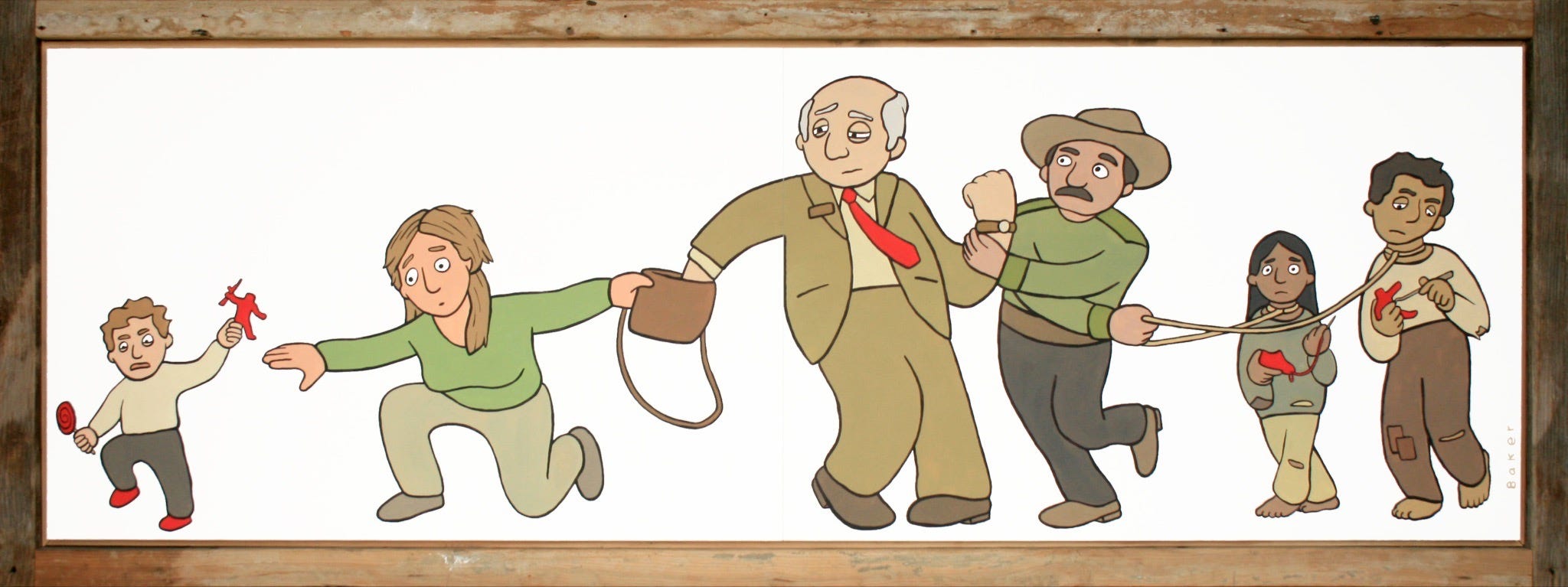
John Bell: Tell me about your story arc as an artist, and when your focus began to shift to liturgical arts. It can start at your childhood, if you’d like - wherever makes sense.
Baker Galloway: I’ll start from my early 20s, because it took me a while to find a creative voice as an artist. It wasn’t until after I became Orthodox that I sort of found that voice in art making. Looking back on it, I think the common thread running through the work of my 20s was exploring subjects of vulnerability - cherishing tenderness, looking at something awkward with humor, making something gross feel playful, treating uncomfortable or untalked-about subjects, or maybe just private and tender subjects, with hospitality and warmth. Sometimes with humor, sometimes just with rawness. That was the theme of the figurative art I was making throughout my 20s.
The question of the arc: I kind of ran out of ideas eventually. In a sense, that early work was a precursor to making icons. I was positioned as an artist making something, and I wanted the viewer to feel, as they looked at the piece, that there was something private and hidden that the artist knew and cared about. There was this intimacy I wanted to communicate - a kind of communion or connection. The work I created from roughly 2004 to 2009 was one long essay about how I see the world and care about the people in it. And I eventually ran out of ideas for how to continue expressing that in my own voice.
There wasn’t really a divine element to it — it was human-to-human. The artwork transcended the physical medium to connect people to people, but there wasn’t anything particularly spiritual about it.
There was a coincidence where I ran out of ideas at the same time that I needed to resume working full-time and stop making art for a while. A kind of valve of artistic output shut off for me at that time. Then, within about a year, I met Vladimir Grygorenko. I asked if I could visit his studio and talk about art, and when I arrived, he simply started teaching me to become an iconographer, which I didn’t really expect. I ended up working with him for a couple of years.
There wasn’t really a through line of what I’d felt was my creative voice, that sense of connection and intimacy and vulnerability, during that period. That part went underground for a good while, until I started working with Aidan Hart, which was another five years later. In the meantime there was a lot of learning of technical skills, and learning the visual language of iconography. I’d never gone to art school, so I needed to catch up on basic drawing and human figure drawing.
Eventually, as I made my way into learning iconography with Aidan’s help, it became clear that I could bring my own voice to the work as an iconographer. There would be a through line. In this case, it was that making a piece of art was no longer me as the artist saying to the viewer, “I see these aspects of your life, and I’m connecting with you about these experiences.” Instead, I was confessing or witnessing to the viewer of these icons that the person depicted, whether Christ or a saint, sees every bit of your life, loves you, prays for you, is with you in your sorrows and your joys. I’m simply doing my best to help make an introduction through the icon to the depicted person, and to give that intimacy of connection to whomever becomes the viewer. But it’s not with me as the iconographer, it’s with the depicted person. That’s the best I can do right now at describing the through line in my arc of development.
John Bell: That’s really interesting. Would you say you weren’t drawing and painting at all before you became Orthodox, or was it just not an organized effort?
Baker Galloway: No, I wasn’t. I did a few drawings, maybe four, in my freshman year of college, when I was really depressed. They were journaling, angsty drawings. Before that I hadn’t had an art class since maybe 8th or 9th grade. It wasn’t until my final semester of college that I got into an art class for non-art majors, and something kind of woke up in me. I’d become Orthodox about a year prior to that.
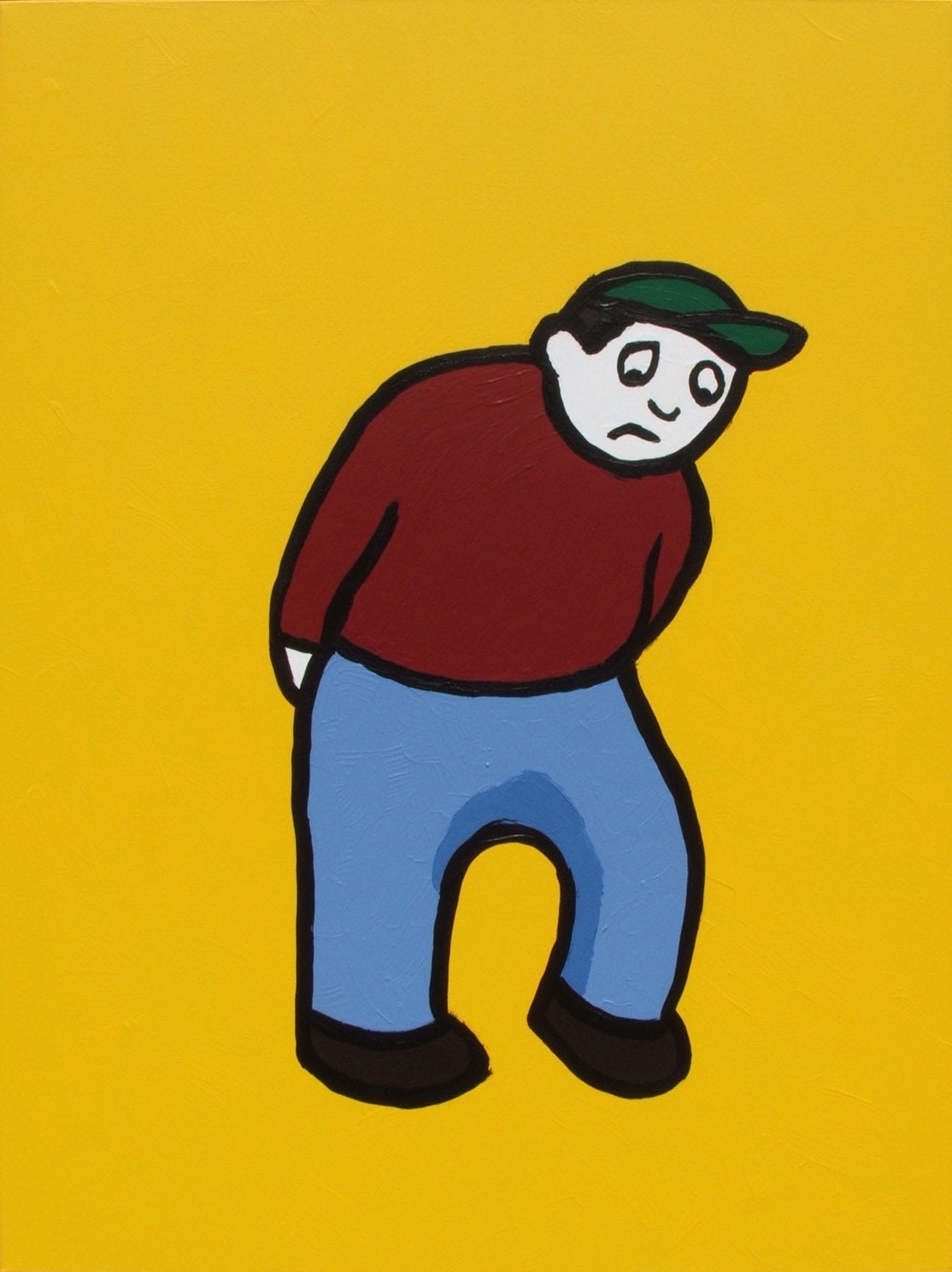
John Bell: When you look at the work you made before you were an iconographer, does it feel half-baked to you? Because to me, even seeing those paintings in real life, being made in real time, they always communicated a type of paternal love that was very Godly. It was from the lens of a father who can see the embarrassment of his child, but presents it in a way that says, “we don’t need to worry about this.” So I don’t think the work was half-conceived. I think maybe the icon is perhaps the highest expression of the same concept, but I’m curious how you feel looking back on those works.
Baker Galloway: Yeah, I still like it. I felt inspired at the time to make a lot of those things — there was an overflowing torrent of ideas coming. It wasn’t separated from my search as a Christian, as a person, to become aligned with that loving vision of others and of myself, and to combat shame. I still have some of them in my house, a few in my parents’ house. I still like them. It’s just a season that has come and gone, and it had an appropriate time. I just don’t have any more ideas in that direction.
John Bell: As an iconographer, it kind of allows you the freedom to take that vision and become a co-author within the Church’s history, the Church’s saints and theology and icons. The completed work doesn’t have to rest solely on your ego’s ability to fully conceive of a whole object.
Baker Galloway: Right, there’s a relief in that I don’t have to play the same note every time in my own style and come up with a brand new, fresh idea every time.
John Bell: Which can be a kind of tyranny.
Baker Galloway: Yeah. For artists, it’s an old story.
John Bell: Was there something else you wanted to say?
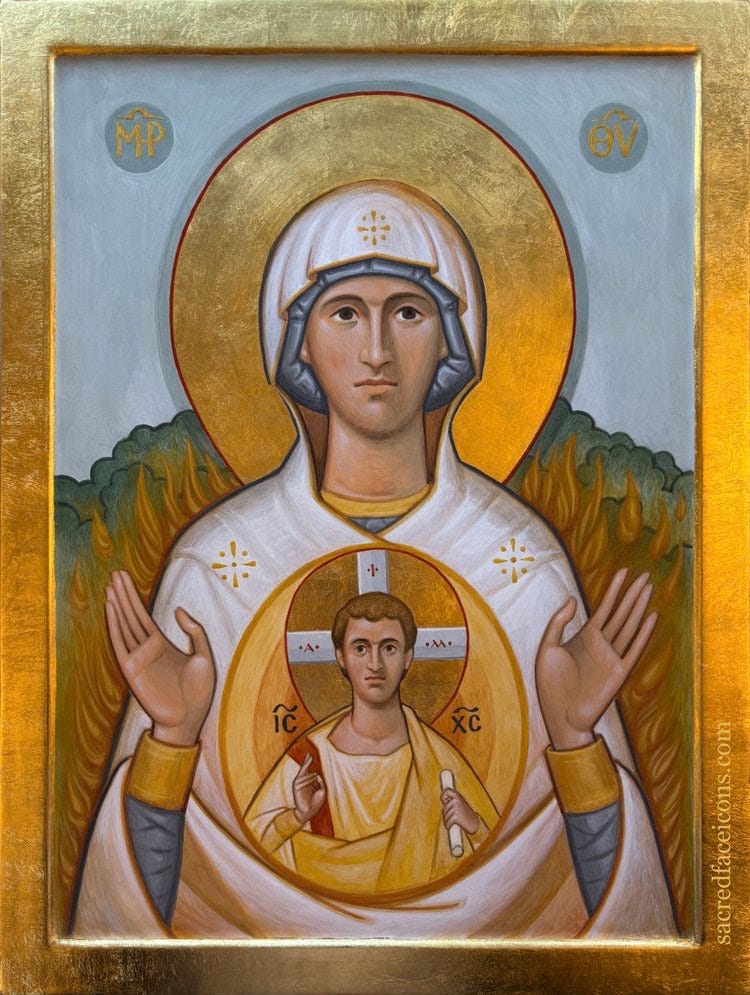
Baker Galloway: Yes. As I was thinking about your question, I remembered a number of very disturbing experiences I had in my young adult life, exposure to horrors and blasphemous atrocities. When it came time to make an icon, I felt the need for the face of Christ, and of the Mother of God especially, that they needed to be expansive enough, capacious enough, to hold that much of human existence in love. It’s another old story: the child who is all of us, throwing a tantrum, trying to get the parent to react in anger — evil trying to provoke love into stopping being love.
I also saw the call of making an icon this way: it needs to be loving enough to be a comfort to the viewer, but sober enough to communicate to the evil that’s in the world that it sees, and recognizes the depth of what’s in front of it — and doesn’t flinch. That’s both the challenge of iconography and what inspires me about it and terrifies me. It’s something I personally need from it, and a kind of power it can offer when done really well. The authority of that kind of face to see all of the tantrum of evil, and to have a love that’s strong enough to outlast all of it to the very end.
John Bell: To look into those depths and yet to remain as still as a pond.
Baker Galloway: I didn’t know that phrase, but yeah, well said.
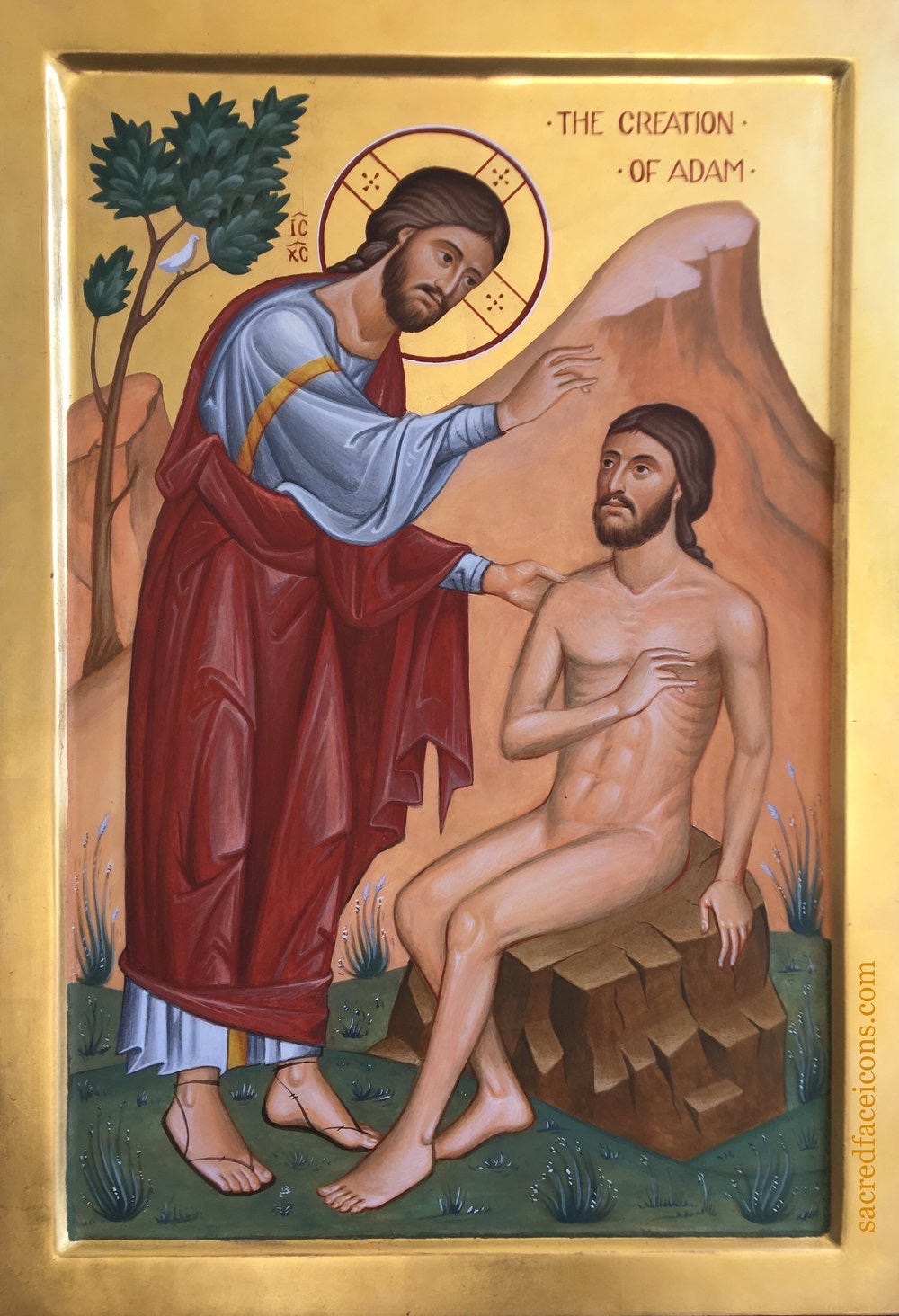
John Bell: I can really see that in how you paint the face of Christ. In other icons, particularly in more complex iconographic scenes and festal icons, Christ is very often depicted in some sort of sliver of the spectrum of His completeness, and that feels unsafe. It feels as if Christ is likely to have some other emotional response if He exceeds the threshold of the sliver He’s being depicted in. Christ is never anything other than everything, and even in a scene with 60 other figures, Christ must be depicted in the fullness of all that He is.
Baker Galloway: Yes.
John Bell: Who are the iconographers you feel most inform or inspire your work?
Baker Galloway: Certainly my two teachers, Vladimir Grygorenko and Aidan Hart. Then my two colleagues who are kind of my best friends in iconography, Seraphim O’Keefe and Martin Earle. And then a couple of people I haven’t met but completely look up to: Olga Sternenko (née Ukhnaleva) and Alexander Soldatov.
John Bell: Is there something that unifies that group, or some quality that makes them examples you invite to inform your work?
Baker Galloway: I’ll speak about Mr. Soldatov and Ms. Sternenko. I get the sense that both of them have a similar requirement of the icon, that there be a personal communion and connection. Both have a mastery of their technical expression and use of paint, but I don’t see their work as sloppy; I see it as free. They exhibit confident control of their expression, but also freedom, so that whenever they paint Christ or the Mother of God, She looks a little bit different every time, and there’s a freshness and vitality to it every time. That tells me they have a searching spirit. They are on a hunt for finding the life in the depiction they’re calling forward to the surface of a wall or an icon board. The stylization and symbolism is incidental compared to the personal connection, which is the primary thing they’re going for. And somehow they manage to be masterful and free at the same time.
John Bell: There’s no evidence of them just running a commission through their personal photocopier - it’s an actual dialogue with, perhaps the person commissioning it, their own spiritual relationship to the saint or the scene, and the whole history of the prototype.
Baker Galloway: Exactly. They don’t just phone it in.
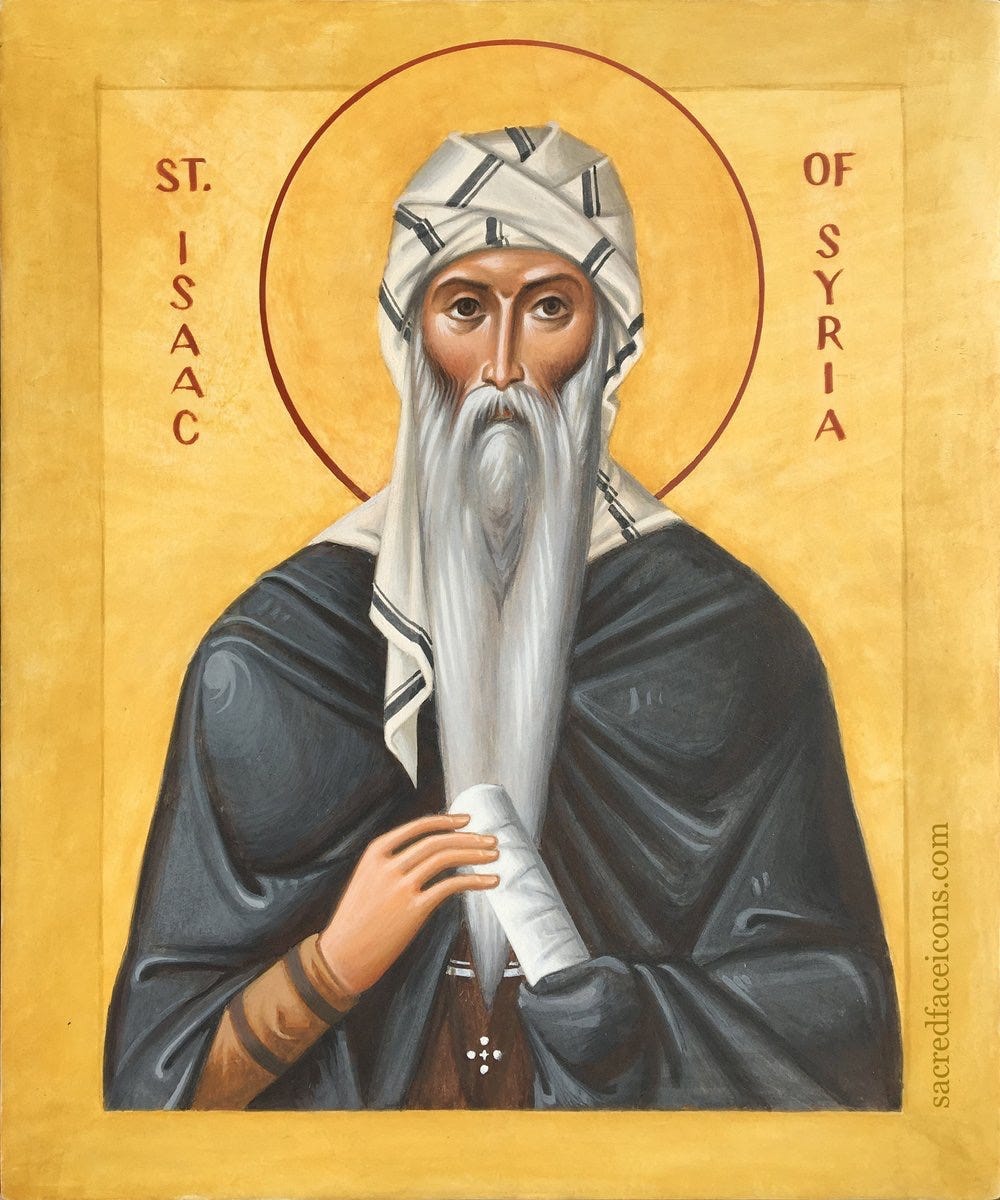
John Bell: You talked about stillness and capaciousness as being important to you. Is there anything else, any other reality that you hold in mind as the highest possibility for your finished work?
Baker Galloway: There are always specific things I’m trying to do, something particular with a green color on this one, or trying something different with gilding on that one. But with the depiction itself, I’m often flooded with an awareness of different anxieties and sinful habits, both on my part and the part of the person commissioning the icon if I know anything about them — if the icon is connected to a grief they have, a memorial, a pain close to them, there’s a sort of an intercessory aspect to the making.
It’s something like what happens in the Divine Liturgy during the Great Entrance, when the priests and deacons go through and everybody reaches out to touch the priest’s garment. We put everything into it. We’re asking this icon to hold all of it. In that sense, the capaciousness is an exploration of how much more the Lord can have mercy on, how many more worries He can stand. It’s a laying-on of burdens, a kind of confessing - challenging this image to hold all the mess.
Which is why sometimes I’ll spend half the time of a project on what looks like a finished icon. I might even have posted it on Instagram because I thought it looked finished. But then I’ll spend more time with it and realize it looks a little smug, or a little too happy, and it becomes intolerable - I realize this image can’t hold everything. So the second half of the project is these micro-adjustments: lightening a little bit of shadow around the eye, pulling one side of the mouth up or down by a millimeter or half a millimeter, to get the expression acceptable enough.
John Bell: I love the idea of you standing before what you thought was a completed icon and thinking: “St. Paul, you look a little proud. Did you just smirk at me?” I should probably remove that from the record.
Baker Galloway: It’s the worst feeling - you should leave this on the record.
John Bell: Do you believe icons have anything special to say to contemporary men and women? In other words, within the canonical understanding of what an icon can and should be to the faithful, is there something unique to our historical moment that icons are accomplishing?
Baker Galloway: I only have one idea about it, really. If we explore the fact that an icon is made of durable materials that don’t change, and contrast that with the images we see on screens or even in print that do change and decompose, we have the opportunity for what, in counseling, is called Unconditional Positive Regard: the requirement that no matter what is said in the clinical setting, the therapist affirms the client and does not dismiss them. To the extent that an icon can’t reject you - it can’t turn up its nose in disgust and leave, it doesn’t go away, it has that to offer. It can’t be repulsed. It’s something real when most everything we see isn’t real.
John Bell: I think the unconditional positive regard idea is interesting, especially coupled with what it would mean to step into a rich encounter with a 9th-century icon — to be a 21st-century person, subjecting yourself to the kind of self-criticism our world specializes in producing, and find yourself regarded by a holy person with the same peace and love and capaciousness you were describing. This contrasts with most of the imagery we’re used to looking at, whether a human being had anything to do with its creation or not, which is designed to sell us an idea or a product, to create a sense of discord, to make us feel lesser. Our economy thrives on timeliness, not timelessness. Images are engineered to deliver micro traumas so that we buy things to heal the micro wounds. To enter into the stillness of an icon that is seemingly from a completely different world, and yet is still our own world - that is a powerful thing.
Baker Galloway: Yes.
John Bell: Do you see any unique problems facing contemporary iconographers, or a challenge you’re personally conscious of?
Baker Galloway: There are not many opportunities to get a basic education in formal drawing in America. Institutions that have art curricula seem more focused on originality, abstraction, and intellectual pursuit than on teaching fundamentals of anatomy or drawing technique. So it’s hard to learn the specific language of iconography when you don’t really know how to draw anything yet. A lot of us, and I’ll put myself in this camp, who do have some drawing skill are, of necessity, self-taught, and have developed quirks in our method that we need to unlearn. Shortcuts and avoided skills have turned into a style, and facing those gaps in your learning curve is really uncomfortable. Going through a good art formation program would probably help a great deal.
A second thing is the culture among Orthodox purchasers of iconography, who have been accustomed to buying reproductions at low cost and seeing iconography as a commodity rather than as a sacramental mystery. They’ve come to undervalue the work required to make good, new icons. So there’s uphill work to do in educating Orthodox people about why you would even bother commissioning original iconography, or even talking about iconography as an art, rather than a thing you buy and put up — the frozen microwave dinner version.
And there are challenges every Christian faces: dealing with ego and jealousy, self-doubt, not giving up.
John Bell: I think what you’re describing more broadly is the collision between American culture and Orthodoxy. When I went to art school, I literally didn’t even make actual, physical art. When I was required to present at critiques, I would just talk about the idea I had and conclude with, ”I may get around to making this work or I may not” - and the professors thought that was brilliant! No one loves modernism more than Americans do, because it’s perfect for our economic machine. And I think we have the same issue in American architecture and church music, we’re trying to reclaim some ground as quickly as we can, but we don’t have enough of our own substance to bring to Orthodoxy yet.
Baker Galloway: I agree, though I’ll add that I had a conversation with two iconographers in Thessaloniki who felt all the big church commissions were going to a group that cranked out the same rote things over and over again — original hand-painted work, but not pastoral or creative, just dry and lifeless, with a dominance of the market. Even there, they had tension and frustration with the machine winning out over the artisan.
John Bell: Right, it’s really just contemporary culture, which is necessarily global now. It’s just more apparent here because we conceived a lot of these global poisons ourselves. And as American Orthodox people, we don’t have an indigenous lexicon of being Orthodox to draw from, so we’re scrambling to make up for lost ground. We haven’t valued classical art instruction for at least 100 years. But I’m sure the Greeks and other communities that don’t have to overcome the lack of a rich cultural Orthodox lexicon are still having to overcome life in 2026 and all of its pitfalls.
What advice would you give someone wanting to commission hand-painted icons?
Baker Galloway: Something simple and basic: be patient. Find iconographers of the highest quality you can, and be willing to wait on their waiting list. Beyond that, I’d say befriend the iconographers you think are doing the best work. Friendship can show up in different ways - there might be drawings, monochrome paintings, or sketches you can purchase from that iconographer that aren’t finished icons, to whet your appetite while you wait. You could send people you know, or go yourself, to learn with that iconographer through painting and drawing lessons. Recognize that there’s a need for more iconographers of high quality, and position yourself as a patron who helps that process unfold, not just to get the immediate product you want, but to help those iconographers continue to thrive and go on to make many more works.
When I’m negotiating a price on an icon, I have to take into account all the expenses of my family’s life: bills, groceries, etc - thousands of dollars a month that has to come from somewhere, and then I have to weigh this against how quickly I can produce work. I should never sell an icon for less than what it takes to support my life, because doing so hurts my ability to continue making icons. I never want to take on a commission that hurts my ability to keep painting. That’s the principle behind why an icon costs what it does. And I personally believe it’s important to have American iconographers, because iconography is a pastoral work, just as preaching and chanting are pastoral works. We want local people doing those works, and we should support local iconographers to do the same.
John Bell: I’d add that it’s important for the patron to communicate any non-binding aspects they are seeking up front - the theological elements of that feast or that saint that one really needs to see reflected in the final work. This should be done without placing so many limitations that the voice of the iconographer is unable to emerge from behind all of those demands. What’s the point in seeking out a specific iconographer if they can’t create specifically? Put the intentions forward clearly, especially anything that would be disappointing to not see in the final work. But the patron should also be willing to say, “I place these requests before you, but don’t let me ruin your icon. It is your icon to paint. I am supporting you in your ministry, and I defer to you.”
Baker Galloway: That’s really good, because it can be discouraging when somebody arrives with a complete set of expectations - “I want an icon of the Nativity, 12” x 14”, by December, with the shepherds and the wise men and the midwives.” And the only variable they offer the iconographer is price. It’s not an exciting thing to submit a proposal for.
John Bell: And scale is connected to that. You need to be asking, “Can you still make a good icon of the Nativity with these elements at the size we’ve been discussing?” If the answer is no, you need to be willing to sacrifice some of those elements, or pay more and allow for a larger icon. Your intentions should never become primary above the success of the icon, and cost is one of those intentions.
Last question: is there a dream commission for you?
Baker Galloway: I’ve thought about a lot of little things I’d like to do, and I’ve done drawings of most of them to satiate the desire - though they’re not always successful when I finally work on them.
What I’d really love to someday paint is a big cycle of the life of King David, ideally a frieze around the upper register of a room, with quotations from the Psalms accompanying different events from his life. His story is capacious, to go back to that word. It holds a lot in one figure: temptation, fall, redemption, repentance, humility, and smallness as a boy. Then fierce courage, the grief that comes with his fatherhood and how his children live, his desire to build the temple and God saying no, being a musician and a warrior at the same time. He’s a real complex figure.
Narrative icons of David are very rare. It’s one of the possibilities I’m considering for the narthex of our temple at St. John’s - either that or The Creation. A lot of my dream commissions are Old Testament subjects - I’ve done three or four drawings for icons of Righteous Bezalel, who made all the artifacts of the tabernacle, and is described in Exodus (31: 1-5) as being filled with the Holy Spirit, which makes him a saint. Thank you, John, for prompting me so thoughtfully, and giving me the opportunity to express things close to my heart.
You can find out more about Baker on his website gallowaystudio.co and follow his work on Instagram at @bakergalloway
Baker, I think from all our conversations that we share the same vision on this, but just to clarify in your interview, I want to ask; When we say things like, "we are looking for an image of Christ or a face capacious enough for us in all our struggles and shame", or "we are asking this icon to hold all of our burden"... it is not so much that we can paint a face of Christ that somehow captures or encapsulates His capacity, or His love, within the painted surface. Rather, we are searching for a way of depicting Him that invites the viewer's gaze towards towards Christ Himself, who truly has that capacity. We are looking for an image that calls our noetic gaze toward Christ, which hopefully does not suggest anything false or negative about Christ, and hopefully does not block anything true and good.
I loved reading every bit of this interview! Thanks Baker and John!