

Minds I
Our epic Pascha to Pentecost Road Trip rolls on.
Hopefully, by now, you know what this is all about: We’re taking this tour so we can encourage all of you to become Liturgical Long-Haulers. Because if this world is going to be transformed—and if we are going to raise enough money to get into our new temple—then we are going to need lots of folks who can pray with persistence.
And to help you get your LLH license, throughout this trip we’ve been sharing Persistence Pointers—and, yeah, at this point, the exact number of those pointers has gotten a bit fuzzy (road trips will do that), but here’s the one we’re going to talk about today: When you pray, you have to use your mind.
Which seems pretty obvious, because, after all, when most folks pray what they basically do is think, and they figure that the Most Holy Trinity just listens in on their thoughts.
The problem with that approach is that most of us really cannot keep our thoughts focused for any length of time. A few years ago, media outlets were telling us that our attention span was less than that of a goldfish; as it turns out, that’s not true. However, most of us know that when we’re just thinking—as opposed to listening to someone or reading a book or watching a screen—we quickly get distracted.
That’s why, in Holy Orthodoxy, we put so much emphasis on the physical component of our prayers. We talked about that in our last post, and the reality is that we are going to be more attentive if we are standing and looking at an icon and breathing the incense and reading our prayers out loud.
But after you’ve been doing that for a while, it gets to be routine. And while there’s nothing at all wrong with routines—especially good ones—the downside is that, when you’re doing something that’s familiar and predictable, your mind will, once again, begin to wander.
So, you can be standing before an icon of our Lord and Master, wrapped in clouds of incense, and quietly reading your prayers…and you can be thinking about how you need to stop by the pharmacy on the way home from work because you have to pick up a prescription.
Sooner or later, if you take persistent prayer seriously, that’s just going to happen; it’s a guarantee. But even though it happens to everyone, it can be pretty frustrating and discouraging.
Thankfully, in the Church, we have several millennia’s worth of experience to draw on when it comes to this sort of thing. And what the Holy Fathers tell us is that, when we pray, if we want our mind to line up with what the rest of us is doing, the key is going to be preparation.
When it comes to our mind, the Fathers often compare it to a grindstone that is turned by a donkey
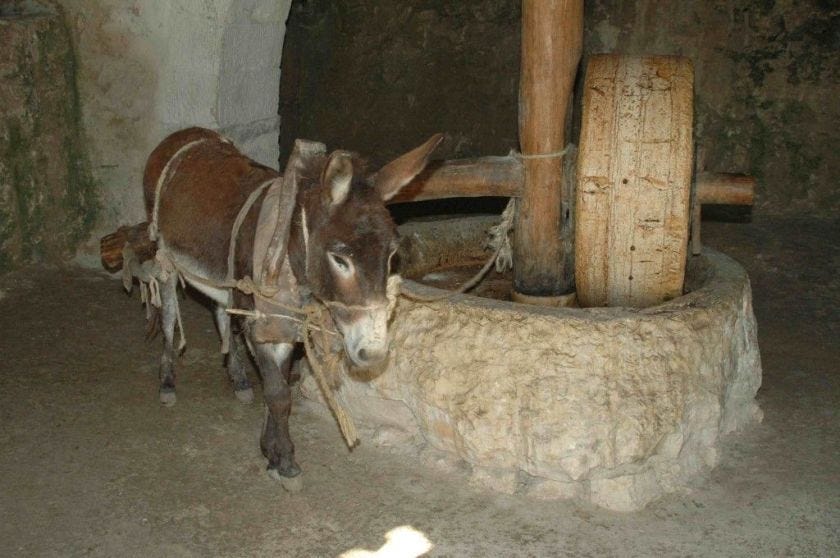
The donkey is going to keep walking; the stone is going to keep turning; what matters is what we are putting into the mill.
In the same way, our mind is always going to be active; it’s going to do what it does, which is generate thoughts. So, the question then becomes: What are we putting into it?
And this is probably one of the biggest challenges that folks encounter when they start to get serious about persistent prayer. Because to be fully present when we pray—both with our body and in our mind—we have to carefully monitor what we are thinking about when we aren’t praying.
Of course, most of the time, a lot of us aren’t thinking. We’re letting other people do that for us, and, in our media-soaked culture, that’s actually easy to do, because there are all sorts of influencers and thought-leaders and content-generators who are happy to do our thinking for us. Shoot, we now even have machines that will do that for us.
So, the first step is to get unplugged. We simply have to stop consuming so much content. And just switching to more wholesome content isn’t, finally, going to cut it, because, the issue is not just the quality but the amount of the content that we take in.
Making that transition can take a long time (and if that means you only read this Substack twice a month, so be it). But once we get to the point where we can be alone without music or a podcast or a streaming service, then what we discover is that we are, ourselves, perfectly capable of generating lots and lots and lots of thoughts.
We re-visit old grudges and think about what we’re going to say the next time we see that person. We obsess over situations at work and plan how we will respond to different scenarios. We worry about family members and wonder how we will deal with their problems. We daydream about old relationships and—well, we all know where that ends up.
Which brings us to the next step: we have to take charge of our own thoughts.
And you’re thinking: “Yeah. Right.”
But remember: In Holy Orthodoxy, we’ve been doing this for a couple of thousand years now, so we know it can be done. Just think back to that image of the donkey and the grindstone: the wheel is going to keep turning, but we can control what goes into the mill. In other words, we can provide our mind with new thoughts.
Or, as the kids used to say, you can “re-thread your head”.
We’ll talk about how that works in our next post. Right now, let’s talk about what you can do to support our temple project.
The most important thing you can do is offer The Akathist for a New Temple with us on a regular basis (PDF/video).
But you can also upgrade your subscription to Paid. You can pick up one of our Come See Something Beautiful hoodies. You can commission an image in the Calming Room of our temple. You can make a direct donation to our Building Fund.
And, while you’re taking care of all that, we’ll buck on outta here with Buck Owens and The Buckaroos