

Two Rooms
If you’ve been reading Come See Something Beautiful for a while, then you know that, when we first started talking about the iconography in our new temple, we had those discussions as a parish community. In fact, those initial conversations took well over a year, and there are still several areas in the temple that we still have not been able to consider in much detail.
But now that we also have lots of folks outside our parish that are supporting our efforts, we thought it would be cool to not only once again pick up that conversation, but, this time, to also include everyone who is engaged with the project through this Substack.
And since we are now in the Season of Great Lent, we thought this would be a great time to focus on two specific rooms in our new temple: the Prothesis and the Oratory.
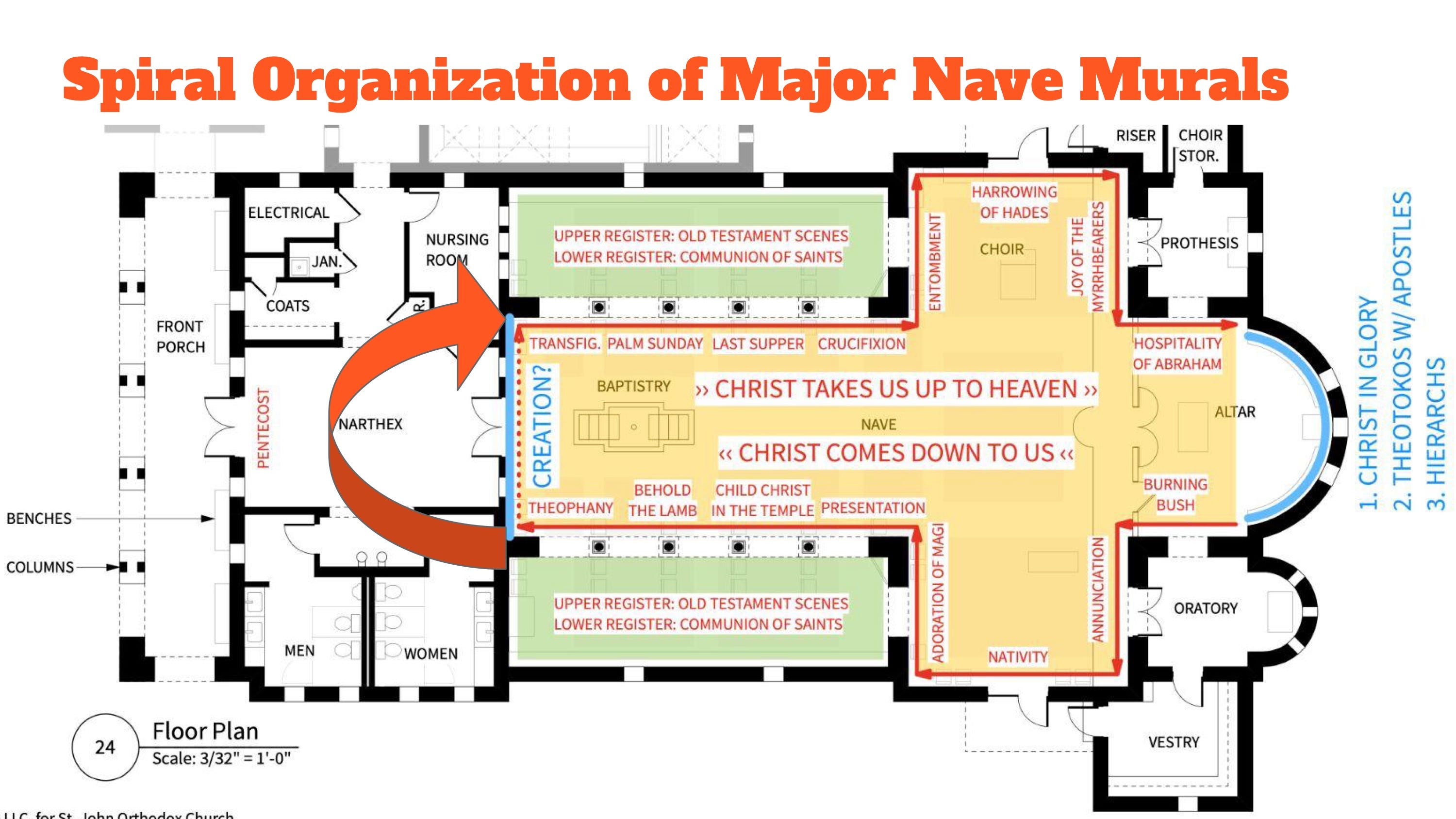
The Prothesis is to the left (or just ‘above’) the Altar; the Oratory is to the right (or just ‘below’) the Altar. Prothesis is a Greek word; it means ‘to place before’; Oratory is Latin; it has its roots in the verb, ‘to pray’. And those two words pretty well sum up what happens in those two rooms: we place ourselves before the Most Holy Trinity, and we pray to the Father, Son, and Holy Spirit, as part of our preparation for, and our participation in, the Divine Liturgy.
We’ve already identified some of the central images that will be in these spaces:
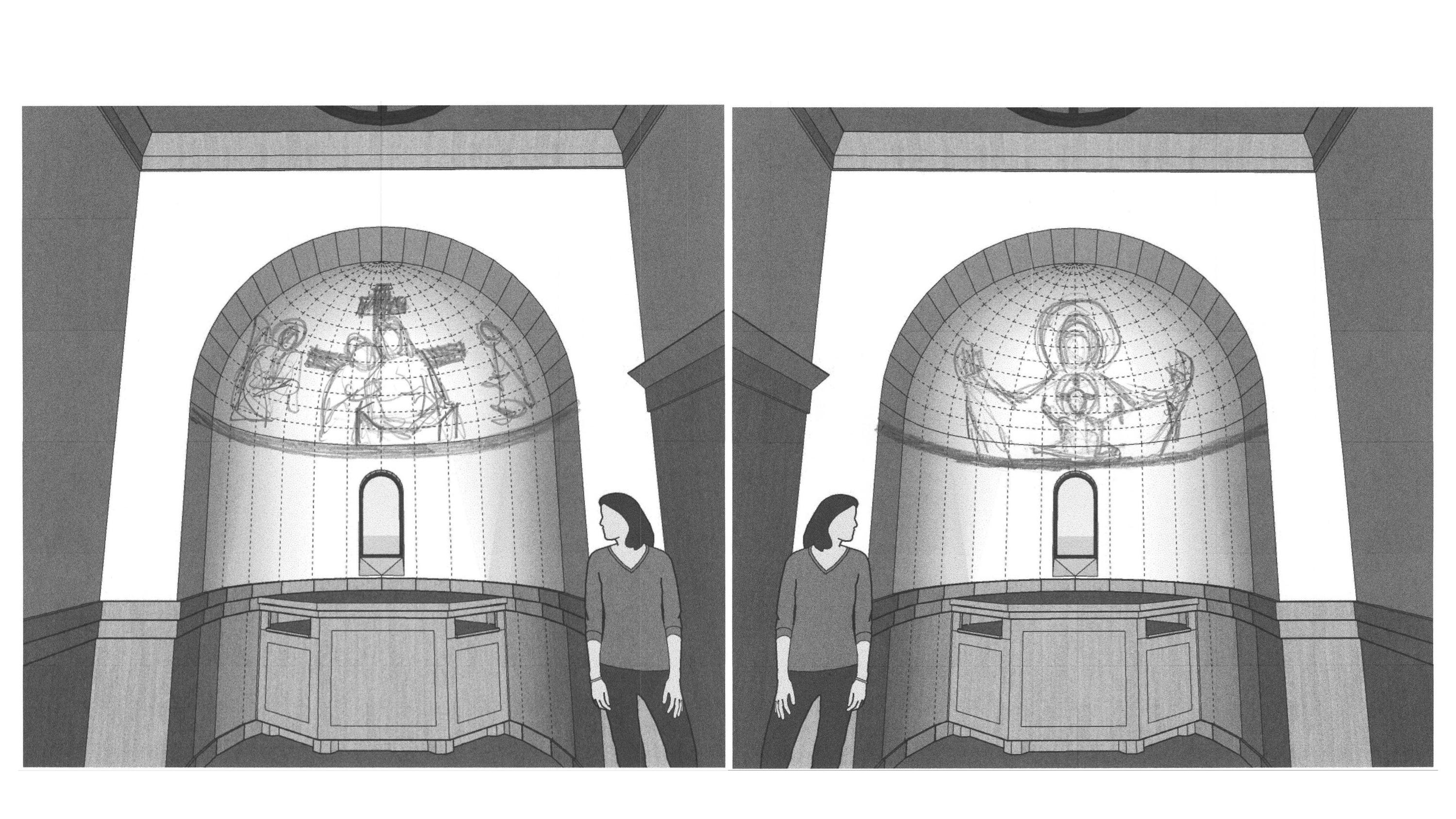
The Prothesis is on the left; the Oratory is on the right. But this might also be a good time to go ahead and answer a question that many of you have asked from time to time: Who is that laid-back-looking person with the long hair and the sweater?
Because that same person also shows up in some of our other slides. Sometimes that individual is wearing a cap and a button-down shirt, but the vibe this person generates is always super-chill. So, when we were having our parish-wide discussions about iconography, we decided this extraordinarily mellow person must be the Angel of Orthodox Architectural Renderings.
In traditional Orthodox iconography, the Bodiless Powers are often depicted in the garments and coiffures of Byzantine courtiers; that’s why the archangels and angels in those historic images have flowing robes and bright hair ribbons.
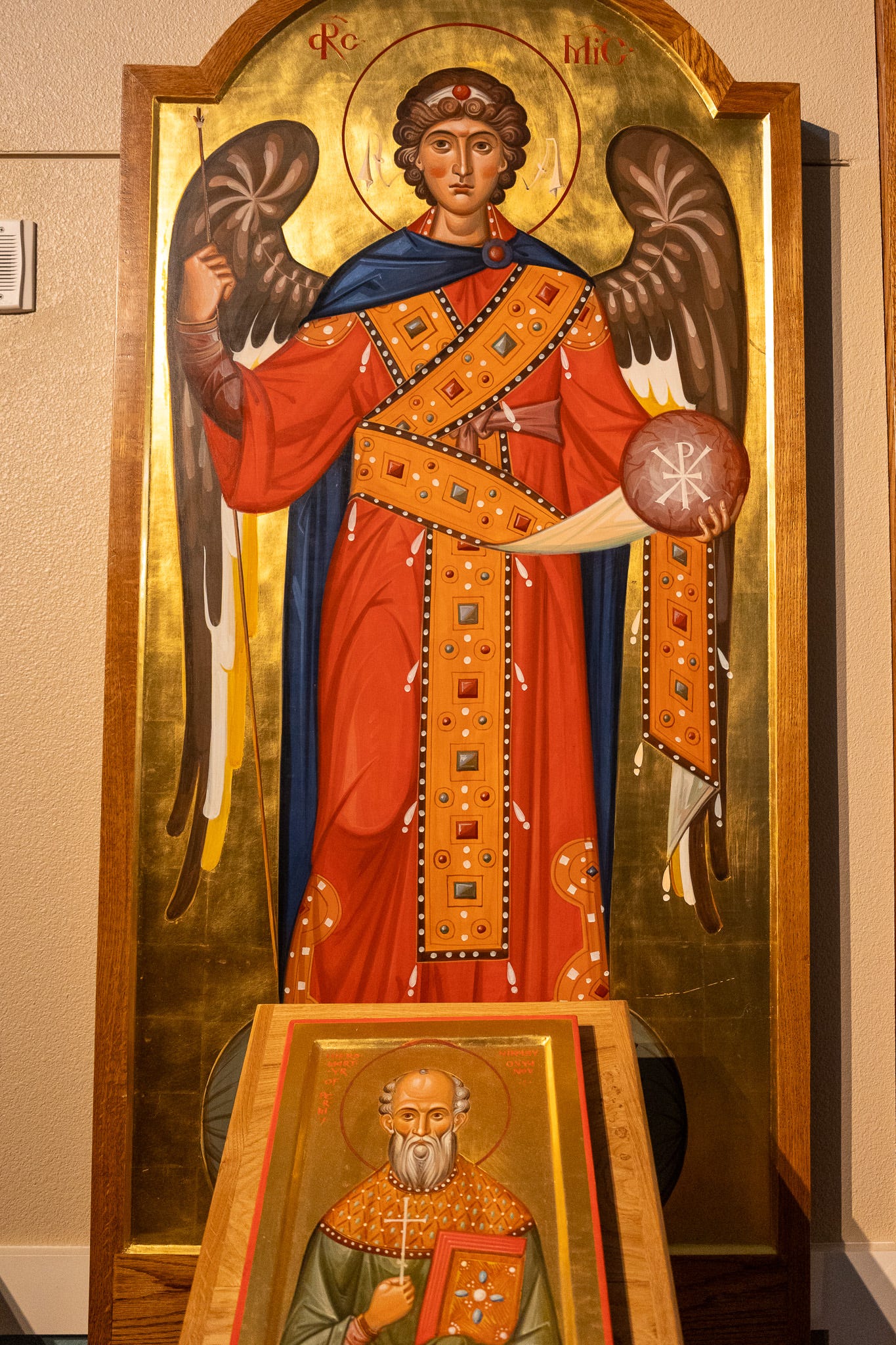
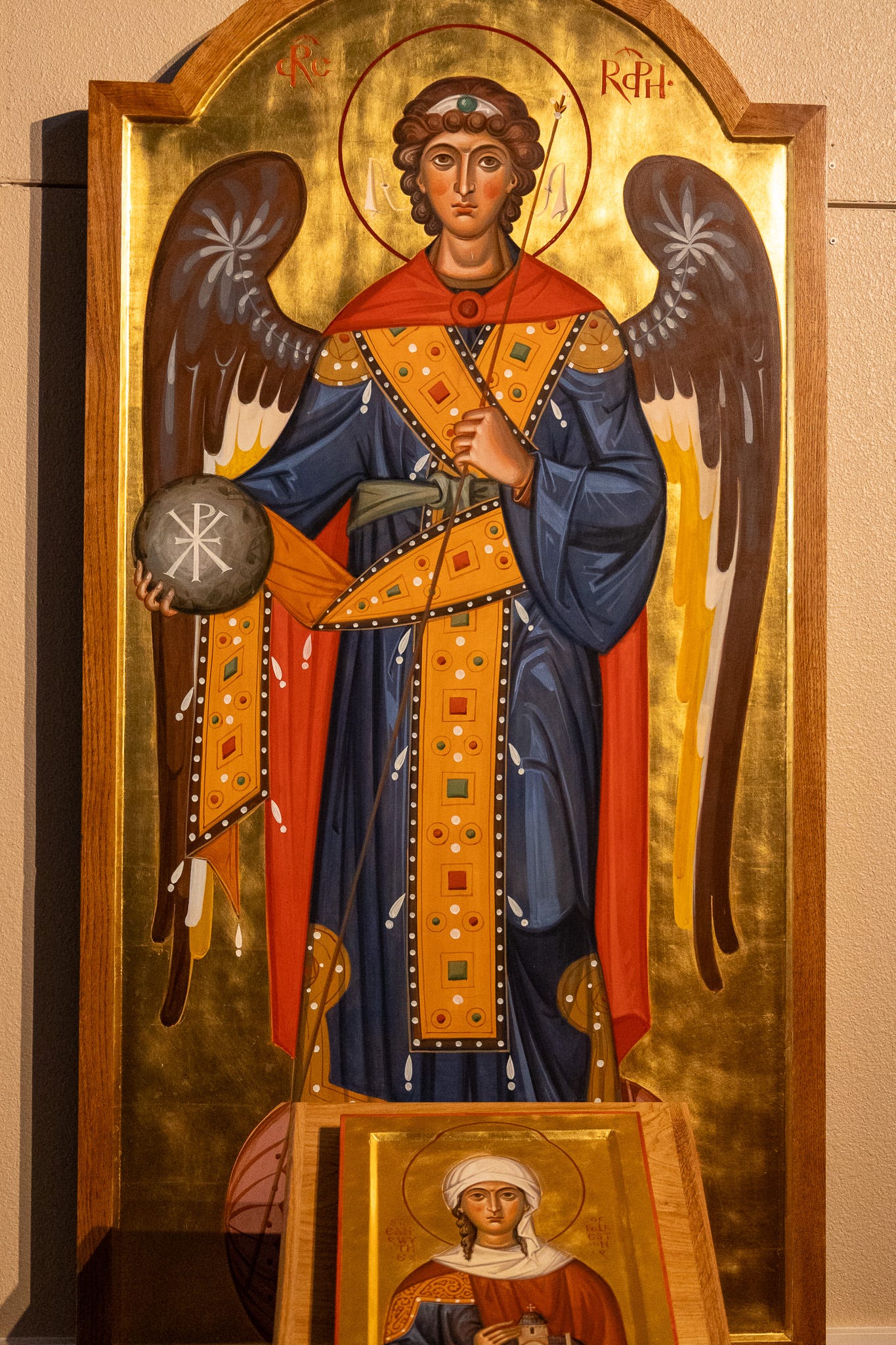
So, we figured it would not be untoward for a 21st century angel to be garbed in business casual. Anyway, that’s who’s doing the whole Game Show Hostess Thing in all of our slides (and if you need to look up that particular celestial job description on The Lord of Spirits Org Chart, just check under Principalities/Presentations).
Now, back to our two rooms.
If we’re going to do a good job with the iconography in these spaces, the best way to prepare for that work is to think carefully about what is going to be happening in those rooms. We’ve already identified those activities—we’re going to place ourselves before the Most Holy Trinity; we’re going to pray to The Father, Son, and Holy Spirit. So, we’ll start with that first activity: the one in which we place ourselves before the Most Holy Trinity.
When we place ourselves before something or someone, what we are doing is making an offering. We are offering ourselves. And, as Orthodox Christians, that concept of offering ourselves is basic to our understanding of worship.
But, in American Christianity, when you talk about an offering, most folks just really think you’re talking about money.
Now, a good many Roman Catholics still have a pretty solid sense that their worship is, itself, an offering, an offering that unites them with our Lord and Master. But Roman Catholics pass a collection basket during their services, or they have alms boxes in their buildings, so there’s also that focus on finances.
However, for your average Protestant, the offering is pretty much all about the business end of worship. It’s when you ‘take up the collection’. When I was a child that activity was a standard part of every single service; in the United Methodist parishes we attended, it was also typically a time for ‘a little special music.’
By the time I was leaving Protestant Land, all the really cool congregations were no longer taking up an offering during their services; it was a way for these communities to demonstrate that they (somehow) weren’t interested in money. By now, I’m sure that fad has gone the way of All Cool Things, but, with our 21st century tech, both Roman Catholics and Protestants are now able to avoid any discomfort when it comes to money, because all you have to do is swipe or tap or click.
There are lots and lots of Orthodox parishes that still do take up an offering during the Divine Liturgy, but, here’s the thing: that’s something we Orthodox borrowed from the Roman Catholics and Protestants. I mean, look in any of the ancient service books; there’s nothing in any of those manuscripts that says, ‘Pass a collection plate at this point’. It’s just not there.
And there’s a reason why it’s not there: There is no provision for taking up an offering during the Divine Liturgy because the entire Divine Liturgy is an offering.
That means, when we participate in that worship service, we show up with everything; we bring all that we are and all that we have; we don’t hold anything back: our money, our relationships, our health, our careers, our hobbies, our dreams, our anxieties, our successes, our failures, even our sins.
That’s a tall order—and, sure, there are lots and lots of folks in lots and lots of parishes who take part in the Divine Liturgy every single week, and, beyond the time it takes to get ready and the gas they put in their cars, they don’t offer anything of themselves. They show up; they light a candle; they greet their friends; they head for the parking lot.
But, as Orthodox Christians, we are called to be as generous as the Most Holy Trinity. And, if you need a way to measure the generosity of the Father, Son, and Holy Spirit, all you have to do is look again at the slide of the Proskemedia that we shared earlier. Because in that space, you’ll see a faint sketch of this image:
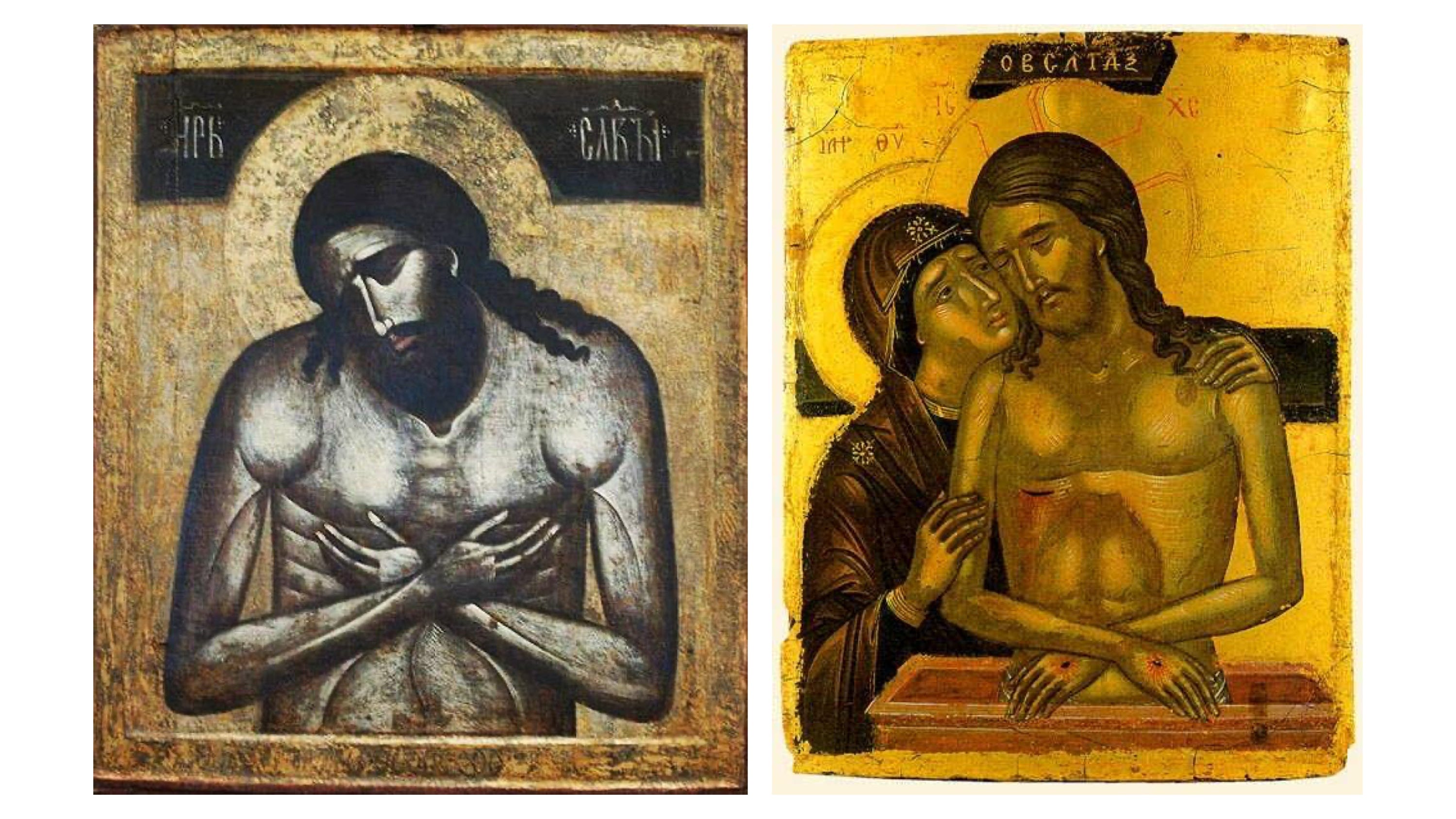
Through the will of God the Father, in the power of God the Holy Spirit, the incarnate Son, Christ Jesus, has given us everything that the Most Holy Trinity has to give. Here’s how St Paul puts it in his First Letter to the Corinthians: “All things are yours” (3.21). And, just in case you’re tempted to think the Father, Son, and Holy Spirit might have withheld a few goodies, the apostle goes on to spell it out in detail for us “whether… the world or life or death or things present or things to come. All are yours”.
That’s why we strive to bring all of ourselves to each and every Divine Liturgy. So that, in gratitude and thanksgiving, we can offer up everything we are and all that we have and everyone that we love and sing along with the priest “Thine own of Thine own, we offer unto Thee, in behalf of all, and for all”.
But, at this point, you’re most likely wondering, “Well, what does that even look like? How do you even do that?”
Those are good questions, but since this post is already running a bit long, we’ll save that for the next time we’re together.
But, hey, since we’re talking about offerings, why not make one right now? You can join us in using The Akathist for a New Temple on a regular basis (PDF/video). You can commission an image in the Calming Room of our new temple. You can purchase some Come See Something Beautiful clothing, or become a paid-up subscriber to this Substack. You can make a donation to our Building Fund. All of that will help us get closer to our new temple, and you’ll be making it possible for our community to make our offerings to the Father, Son, and Holy Spirit in a facility that is, itself, a beautiful offering.
While you’re making that offering, we also have a ‘little special music’: Natalie Merchant singing about generosity and gratitude:
I think it was some where between 1996 and 1999 that this song played often and I put it in my Jesus song mix cd:)
Kinda brought a little tear to my eye, because I had some particularly difficult things in my life that ended in thanks and it was nice to remember them. :)
“Thine own of Thine own …” was one of the first declarations in divine liturgy that stopped me in my tracks. I really didn’t even “get it” but felt like it was a call to BE His own and bring ALL to Him. It shined a light on all I hold back (it still does), and all the manifold ways He out-gives , as the offering and offerer. It never gets old. 🥹By His mercy, one day, I’d like to find myself spent for and before Him. At least a halfway fragrant offering…May it be so.