

Proskomedia II
So, in our last post, we walked you through what happens during the service that’s called the Proskomedia. That service takes place in a room that’s called the Prothesis, and, in case you’ve forgotten where that room is going to be located in our new temple, we’ll give you another look at the layout:
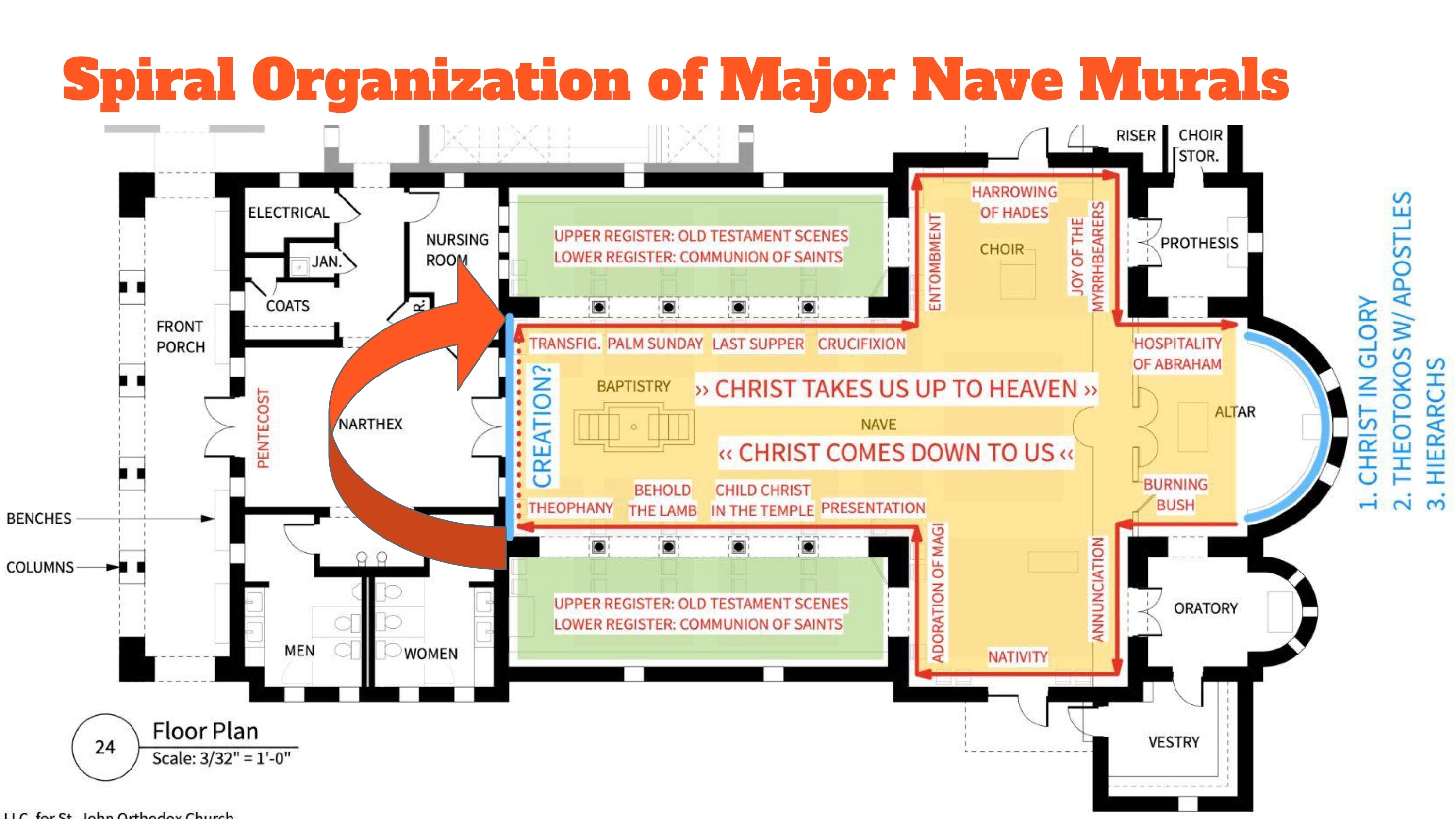
Remember? The Prothesis is just to the right (or just ‘above’) the Altar.
Okay, now that we’re all oriented, let’s review what exactly it is that we’re up to: We’re talking about all this, because, we’re thinking through what the iconography in that room should look like. We’ve already identified a general and central image, but there’s still a lot of space for a lot more iconography.
However, before we tackle the next topic on our list, there are probably more than a few things that are puzzling you: Like, how can you have a worship service in a room that’s so small? And, why would you try to hold a service in that confined space when you’re just a few feet away from that big open yellow space called the nave?
Those are good questions, but the first thing you need to understand is that the only people who directly participate in the Proskomedia are the clergy: the priests and the deacons. So, the room in which the service is offered just doesn’t have to be that large.
But the reason we don’t serve the Proskomedia in the nave is because, when the Proskomedia is offered, a different service is going on in the nave. That service is Orthros. Orthros is the service which precedes the Divine Liturgy, so, on a typical Sunday morning, the Proskomedia and Orthros are happening simultaneously.
As in, at the very same time.
Which, I know, is going to blow the mind of all you linear, hyper-rational, one-thing-at-a-time, Western-type folks.
I know that because it took me a while to get my head around the fact that worship services can happen simultaneously. But that works in Holy Orthodoxy because our worship is not, finally, directed to the folks who are in attendance. Our services are offered to the Most Holy Trinity.
And the Father, Son, and Holy Spirit can keep track of more than one thing at a time.
So, just as the Most Holy Trinity can rejoice over a whale that’s breaching south of Baffin Island in Hudson’s Bay and also be totally present for a woman who’s giving birth in Shymkent, Kazakhstan, in the same way, the Father, Son, and Holy Spirit can rejoice in the hymns that are being sung at our chanter’s stand and also pay full attention to the intercessions that are being offered in the Prothesis.
Of course, that is just all kinds of amazing, and it’s just basic Christian doctrine, but a lot of you are probably still wondering why we don’t allow other folks to be present at the Proskomedia or why we don’t just offer that service in a way that makes it possible for more people to participate?
Well, it’s not that other people are somehow prohibited from entering the Prothesis. As you can see from the slide we just shared, there’s going to be a storage closet for the choir that will open out into that space, and, presumably, from time to time, one of our parish musicians may need to come into that room to retrieve something from the closet.
And it’s not like folks are forbidden from seeing or hearing what happens in the Proskomedia. In our last post, we shared a good portion of that service with you, and the entire order of worship is available online. Also, people who are in the nave can often see what’s going on in the Prothesis through the doors of the iconostasis and, when there is a pause during Orthros, they can frequently hear the priest and the deacon who are serving in that space.
So, it’s not like there is anything secret or hidden or gnostic about all this. The Prothesis is not an expression of priestcraft or clericalism. It’s about having a dedicated space in which the clergy can do some of their most characteristic work: intercession.
Folks often have all sorts of ideas about what it is that clergymen do. Some people think we spend most of our time in study and in preparing sermons; some people think we devote a lot of our energy to counseling; some people think that we put a great deal of effort into evangelism; some people think that we are administrators or fund-raisers or teachers.
All of those things are part of the overall job description, but, in Holy Orthodoxy, one of the absolutely essential things we do—some would say, the main thing that we do—as priests and deacons is pray for our people. We unite our intercessions with the Intercessions of our Great High Priest. And having a specific room in which we do that particular work communicates just how important it is.
And if an usher slips in with a list of names to add to the prayers, that’s not a problem. If a chanter sticks her head in the door with a question about Orthros, no one gets bent out of shape. Again, the Prothesis is not a space that off-limits to everyone who is not clergy. But we try not to distract or disturb the priests and deacons who are praying for all of us.
Because we need those prayers.
We need them desperately.
But we don’t have to hear those prayers for them to be effective. We don’t have to be present at the Proskomedia for that service to have an impact. From time to time, you’ll hear Orthodox Christians suggest that the Proskomedia should be offered in a way that allows as many people as possible to participate. There are even temples in which the Prothesis is open completely open to the nave, so that the service is basically offered in full view of whomever is present.
But having a separate, dedicated room allows us to develop the kind of faith the centurion expresses in the Holy Gospels (St Matthew 8.5-13; St Luke 7.1-10).
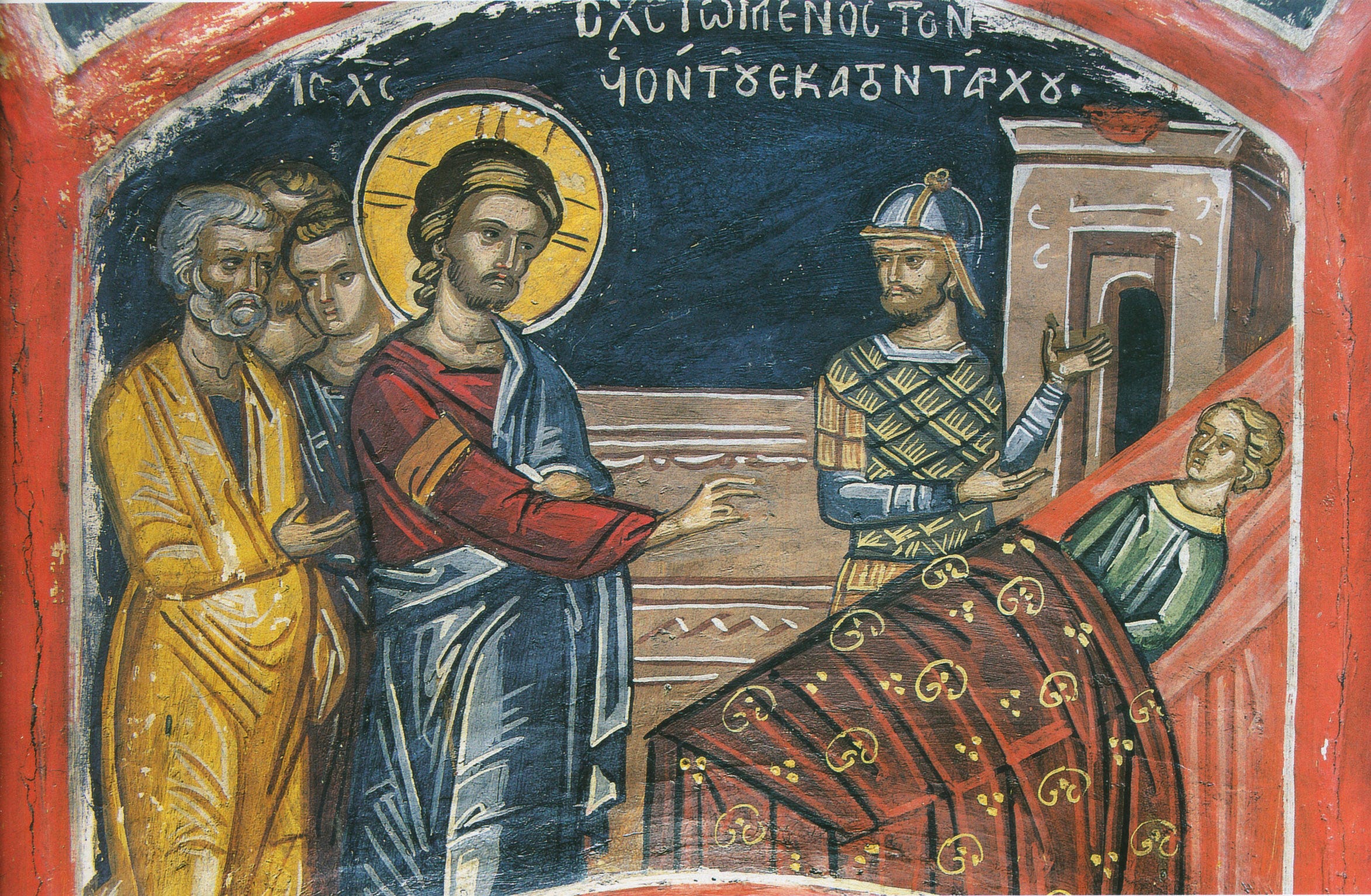
The centurion didn’t need to have Christ Jesus come to his home; he didn’t need to see our Lord and Master at work. In the same way, we can rest in the knowledge that our priests and deacons are interceding for each of us and for all of those whom we love, and that the Great High Priest will hear those prayers.
And, in our new temple, we will be praying for each and every one of you—which is a really good reason to help us with the whole project.
So, by all means, read the Akathist for a New Temple with us on a regular basis (PDF/video). Take out a paid subscription, purchase some official CSSB merch, commission an image for the Calming Room of our temple, or make a direct donation to our building fund.
Since we’ve been talking about the Proskemedia, a service that is offered simultaneously with the Service of Orthros, we’ll sign off with one of the hymns that is being sung at Orthros during this Lenten season.
Thank you for your prayers!