

The Heart
So, we’re sailing on in! We’re crossing the finish line!
That’s right! Our trek from Pascha to Pentecost is winding down—or, really, we should say, it’s coming to a climax.
Because the whole reason we undertook this epic road trip is so we could equip all of you out there to become Liturgical Long-Haulers. An LLH is someone who prays with persistence, and we need lots of those if we’re going to raise more-than-a-million dollars for our new temple.
But we timed the trip perfectly, because, here we are, on the Last and Great Day of Pentecost, and we’re ready to share with you that final Persistence Pointer—and, for sure, it’s the most important one of all: You have to pray with your heart.
Of course, that’s the goal for each and every Orthodox Christian, but, generally speaking, it’s only the Liturgical Long-Haulers who get there because connecting with your heart requires a lot of preparation.
We’ve been talking about that preparation in these last few stages of our road trip: You have to clean all the external stuff out of your mind; you have to get a handle on all the internal stuff that your mind produces; basically, you have to replace your old way of thinking with an entirely new way of thinking, and Holy Scripture is the go-to source for those new thoughts.
And all that just takes a long time.
But, eventually, you get to the point where you realize that your mind is pretty much always focused on the Most Holy Trinity.
For example, there’s a prayer that’s read every evening at Small Compline, and, in that prayer, we ask Christ Jesus for “the grace to glorify Thee all through the night”. And, when you’re a Liturgical Long-Hauler, you can do that. Now, that doesn’t mean you stay up all night and read prayers—though lots of folks get up and do that. No, what that prayer is referring to is that when your mind is zeroed in on the Father, Son, and Holy Spirit, you will be able to maintain that focus even when you are asleep.
Which is how most people first connect with their heart.
In Holy Orthodoxy, there is a vast amount of literature about the heart: what it is, how it works, what we need to do to nurture and guard it. But this is the easiest way to get a handle on it.
The Holy Fathers teach that our soul has spiritual senses just as our body has physical senses. The processing center for those spiritual senses is also the center point of our soul; we call it the heart—and, yes, some of the Fathers actually locate this spiritual heart in the center of the chest. But as the mind is to the brain, so is our spiritual heart to the organ that pumps blood through our body; there’s a connection in both instances, but, also, in both instances, the spiritual reality is just way bigger than the physical reality.
So back to that moment when you realize that you’re basically praying when you’re asleep.
There’s a beautiful verse in the Song of Songs that the Fathers point to when they are talking about that experience: “I sleep, but my heart awaketh” (5.2). And, again, for most Liturgical Long Haulers, that’s when it dawns on us that, when we pray, we are simply joining in an activity that is already on-going. In other words, we begin to figure out that prayer is not something that we produce or generate; it is something in which we participate.
And the point, the place, where that participation happens is our heart. It is, again, the center of our soul, and the Fathers try really hard to describe that means: The heart is our Holy of Holies. The heart is the point at which heaven and earth meet. The heart is our door to the Kingdom. The heart is Mt Sinai and Mt Tabor. The heart is the Garden of Paradise.
But here’s what all those lovely phrases finally mean: our heart is the place where the Father, Son, and Holy Spirit are waiting for us.
Now let’s pause here for a minute and let that sink in.
No. Just sit with it a bit longer.
Because what we’re trying to comprehend, what we’re trying to grasp, what we’re trying to get our heads around is that the Most Holy Trinity really does actually dwell within us. And that means our prayers are truly joined with the songs of the seraphim and the chanting of the cherubim and the praises of the saints. So, in our hearts, we are swept up into the doxologies of the Kingdom. We don’t offer intercessions; we don’t say prayers; we are borne up on exaltation.
The word the Fathers most consistently use to describe that experience is glory.
Which means, in our hearts, we have access to the same glory that the Holy Prophet Moses saw in the burning bush and the same radiance that descended upon the Tabernacle of Witness and the same bright cloud that filled the temple of the Holy Prophet Solomon and the same luminous billows that the Holy Prophet Ezekiel described in his vision and the same effulgence that shone in our Lord and Master on the Mount of Transfiguration and the same divine beauty that was revealed in and through the Cross of Christ Jesus and, also, in and through His Resurrection.
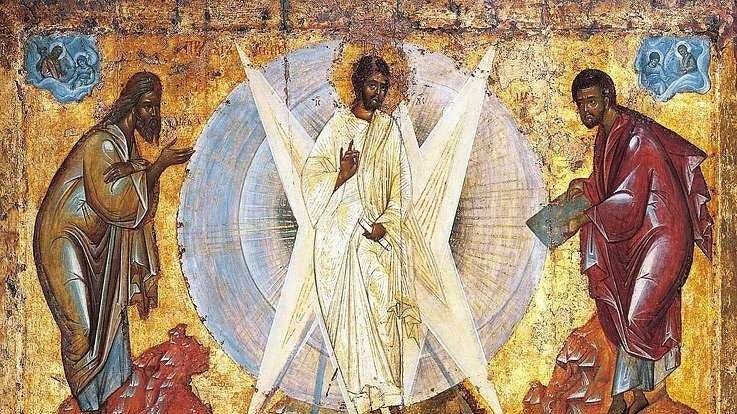
And this is where all our talk about Liturgical Long Hauling connects directly with what we want to do with our new temple. Because what we experience when we are able to pray from the heart is what we want to make manifest in that building: The Glory of the Most Holy Trinity.
Which is why, all along, we’ve been saying we are building this temple from the inside out.
And we sure hope that you’ll help us out with that.
To begin with, you can join us in offering the Akathist for a New Temple on a regular basis (PDF/video).
You can also upgrade your subscription to Paid; you can pick up some of our Come See Something Beautiful merch; you can commission an image in the Calming Room of our new temple, and you can make a donation directly to our Building Fund.
And since we’re wrapping up the Pascha to Pentecost Tour, we’ll “Boogie on Back to Texas” with Asleep At the Wheel.