

The Porch
During Great Lent, we spent a lot of time talking about the east end of our new temple. Now that we’ve celebrated Pentecost, we’re going to move to the other end of the building.
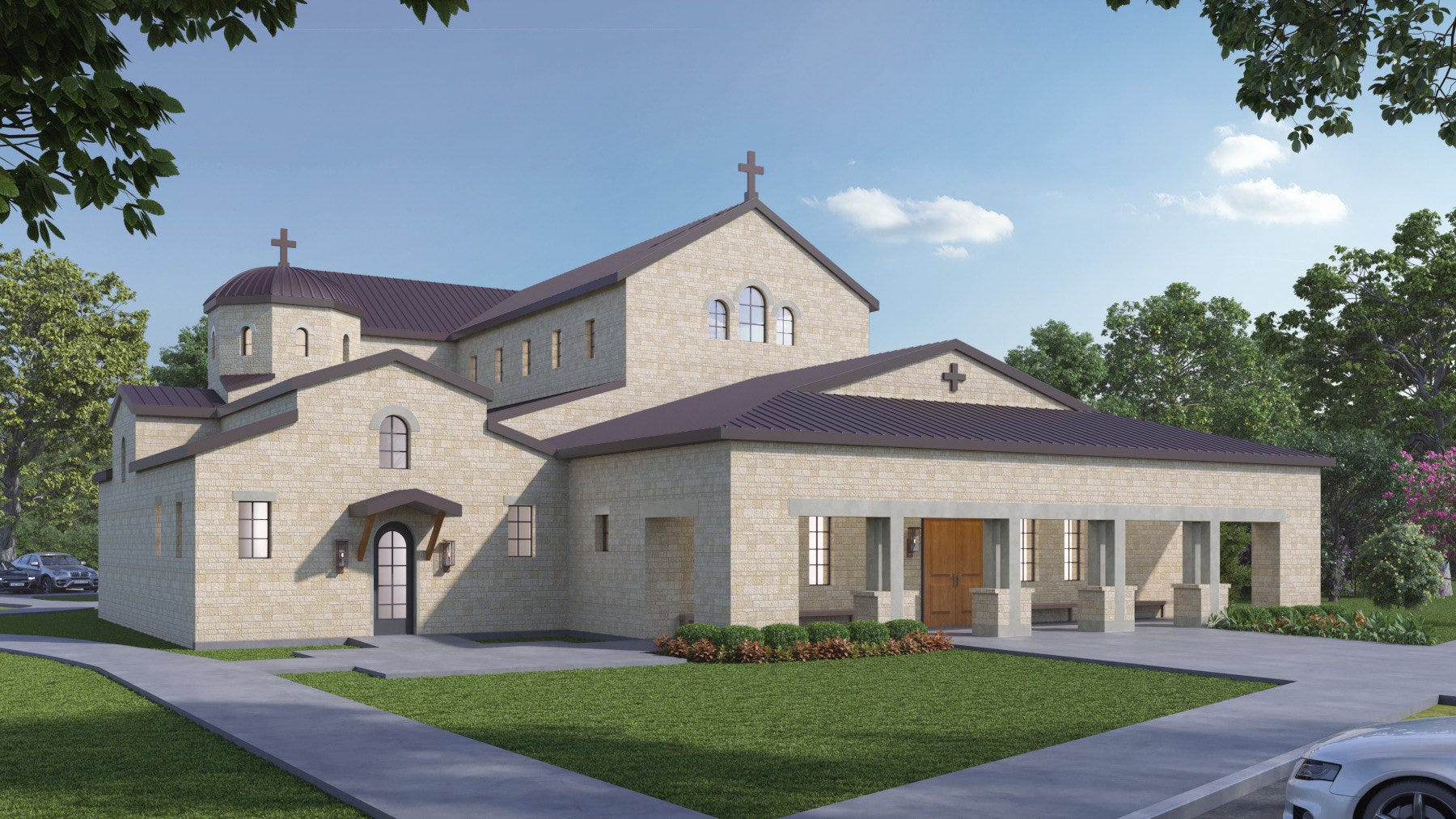
As you can see, there is a substantial porch on the front of that structure. In most contemporary public buildings, that sort of feature is only intended to shield folks a bit from the weather and to make the exterior of the structure a little more inviting. In other words, no one expects people to pause or gather in that area; it’s just an attractive way to facilitate folks getting in and out of the building.
But in Orthodox temples, the porch is actually used in the Divine Services.
For example, on the night of Pascha, we went outside and processed around our current building. When we got back, the front doors were closed, and the lights were all off. We gathered together on the porch and out on the front lawn; then the priest took up a cross and banged three times on the doors, while shouting these verses from Psalm 23: “Lift up your gates, O ye princes, and be lifted up ye everlasting gates, and the King of Glory shall enter in!”
Then, from within the darkened building, one of our readers shouted in reply, “Who is this King of Glory?”
The priest responded: “The Lord strong and mighty, the Lord, mighty in war!”
Side Note: In case you haven’t figured it out, the reader is pretending to be The Devil. The guy in our parish who has played that part for the last few years puts a Jack Black level of enthusiasm into the role.

(honestly, if you’re the priest knocking on the doors, it’s almost impossible to keep a straight face).
That dialogue continues for a couple of minutes, then the doors swing open, and we enter the building singing “Christ is Risen!” while all the lights are turned back on and all the candles are once again lit.
And all of that happens out on the porch. But, in earlier centuries, the porch was used for lots of other things.
For example, during the first millennium, parish communities consisted of a number of different groups:
There were what were called The Faithful; these were folks who had been baptized and chrismated and who were able to participate in the Holy Eucharist.
Then there were The Catechumens; these were folks who were officially being instructed in the Faith—and, in most cases, that was a multi-year process.
There were The Hearers; these were people who were just starting to explore Christianity.
There was a group called The Penitents; these were folks who had been baptized and chrismated, but they had fallen into serious sin, and they had been instructed to abstain from the Holy Eucharist for a period of time.
Finally, there was a group called The Demoniacs. No kidding. It’s not clear exactly who this designation referred to. Some scholars speculate that most of these folks would today be regarded as mentally ill or emotionally traumatized, but what is clear is that the people in this group had little control over their own lives.
But out of those five groups, only The Faithful stayed for the entire Divine Liturgy; at various times during the service, everyone else was blessed, and then dismissed. We still do that today, but the only folks who are blessed are The Catechumens and The Faithful, and no one has to leave. But, in the early centuries of the Church, after they were blessed, The Catechumens, The Hearers, The Penitents, and The Demoniacs all went out and stayed in the porch of the temple.
And, oddly enough, something similar still happens in Orthodox communities.
Most folks notice it when they first start visiting Orthodox Land: As they go into the temple, they’ll see a group of men standing on the porch. The visitors figure those men are just catching up with one another and that they will later head into the service, but, after the Liturgy has ended, when the visitors are leaving, they notice the same group of men standing on the porch. Clearly, none of those men actually went into the temple; they were out on the porch the entire time.
Side Note: In parishes that serve largely ethnic communities—Arab, Greek, Slavic—the group of men on the porch would also, invariably, be smoking.
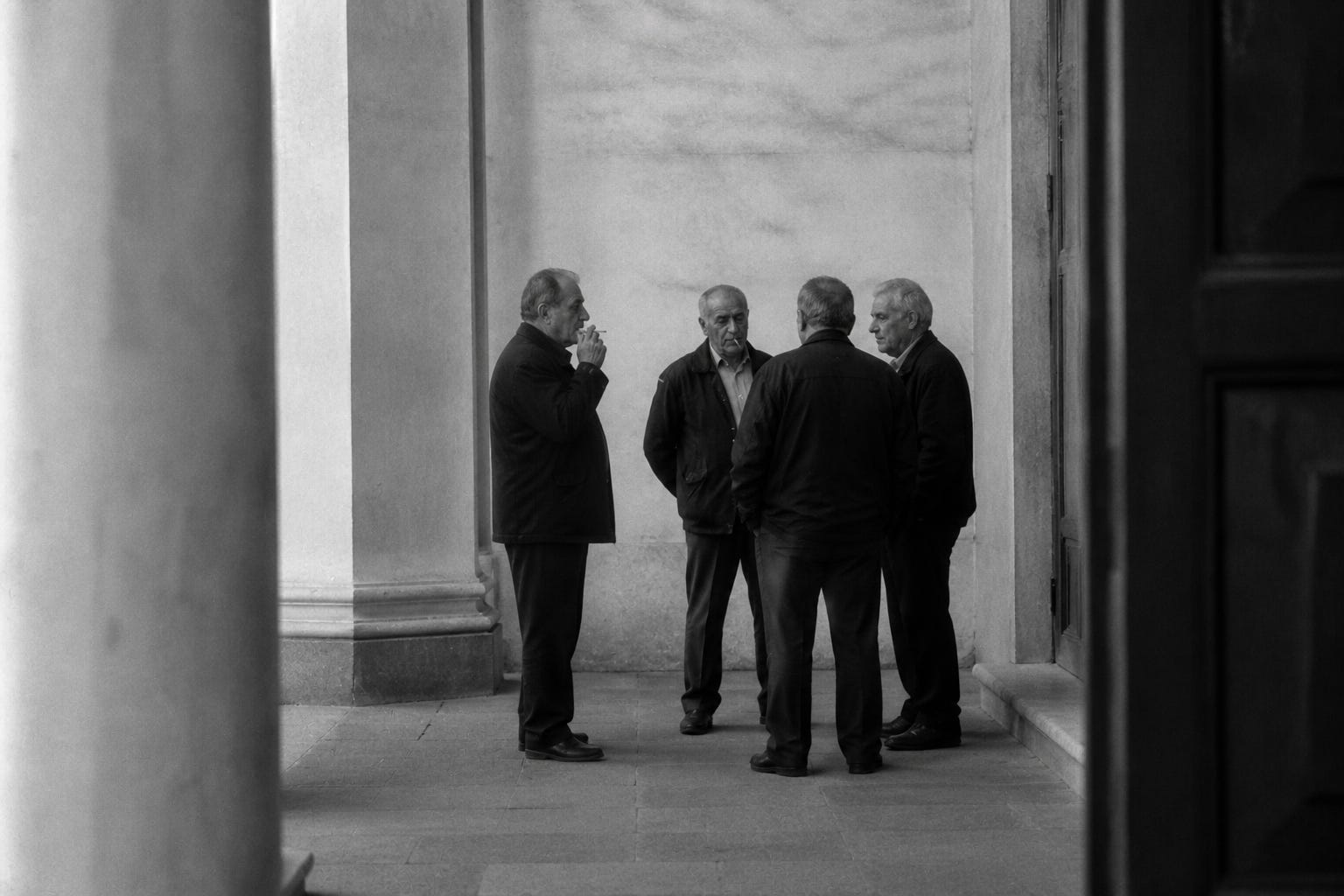
Because we are what is often called a ‘convert parish’, we don’t get a lot of old guys smoking out on the porch—but what we do get are parents who need to take a break with their preschool child and then they stretch the break out as long as they can, and people who went to the restroom and then ran into a friend in the narthex and then stepped out on the porch to visit, and middle school kids who told their parents they just had get a drink from the water fountain but somehow were never able to make it back into the service.
And there are people in our parish who are scandalized by everything that’s going on out there on the porch, and they often tell the priests that Something needs to be done.
But, in her ancient wisdom, the Church recognizes that we don’t all come to the Father, Son, and Holy Spirit at exactly the same pace. Some folks are going to want to be nose to nose with the saints that are depicted on the iconostasis; some folks are going to want to be at the edge of the crowd—and, for some people, it’s enough just to stand out on the porch.
And, of course, standing in the porch is probably an expression of insecurity or doubt or fear or shame, at least at some level. The good news—The Gospel—is that all of that insecurity and doubt and fear and shame will be healed, but that’s not going to happen because we force everyone to go inside the building. The Most Holy Trinity is patient—infinitely so—and the Church can afford to be, as well.
Which is why our new temple will have an inviting porch, with benches and lots of shade.
Tracy Lawrence has an old song called, “If the World had a Front Porch”. We’ve got that video ready to stream at the end of this post, but, actually, the porch on our new temple will be for the whole world. We’ll unpack what that means in the weeks ahead.
And we just know you want to support a community that is working hard to be that welcoming. So please join us in offering the Akathist for a New Temple each week (PDF/video); go ahead and restack this post and then upgrade your subscription to paid; purchase some of our Come See Something Beautiful clothing; commission an image of a departed pet for the Calming Room of our new temple; make a donation to our building fund. All of that money will go to fund that new temple and that lovely porch.