

Weekend Update 5/22
“Let every breath praise the Lord”


That’s a line from Psalm 150; it’s a phrase that shows up a lot in Orthodox worship.
And what you see in those photos is our fantastic choir fulfilling that Biblical calling under the direction of Benedict and Talia Sheehan. The Sheehans are two of the world’s foremost choral clinicians; Benedict has composed a musical setting for our Divine Liturgy; Talia has coached our choir for several years. They were both at St John’s a couple of weekends back for a workshop,
and you can sample some of the amazing results here:
Now, if you’re new to Holy Orthodoxy, when you listen to that kind of recording—or when you actually participate in the Divine Services—you can’t help but wonder what, exactly, sets those pieces apart from other worship music?
Of course, there’s the fact that we don’t use any instrumental accompaniment.
And, in our parish, there’s also the reality that just about everybody sings along.
But if you stick with the question, you realize that the answer actually goes deeper than just the absence of instruments or the presence of congregational singing.
And, recently, I read one of the best takes on that answer in an interview with our very own Baker Galloway.
“Praise ye God in His saints”
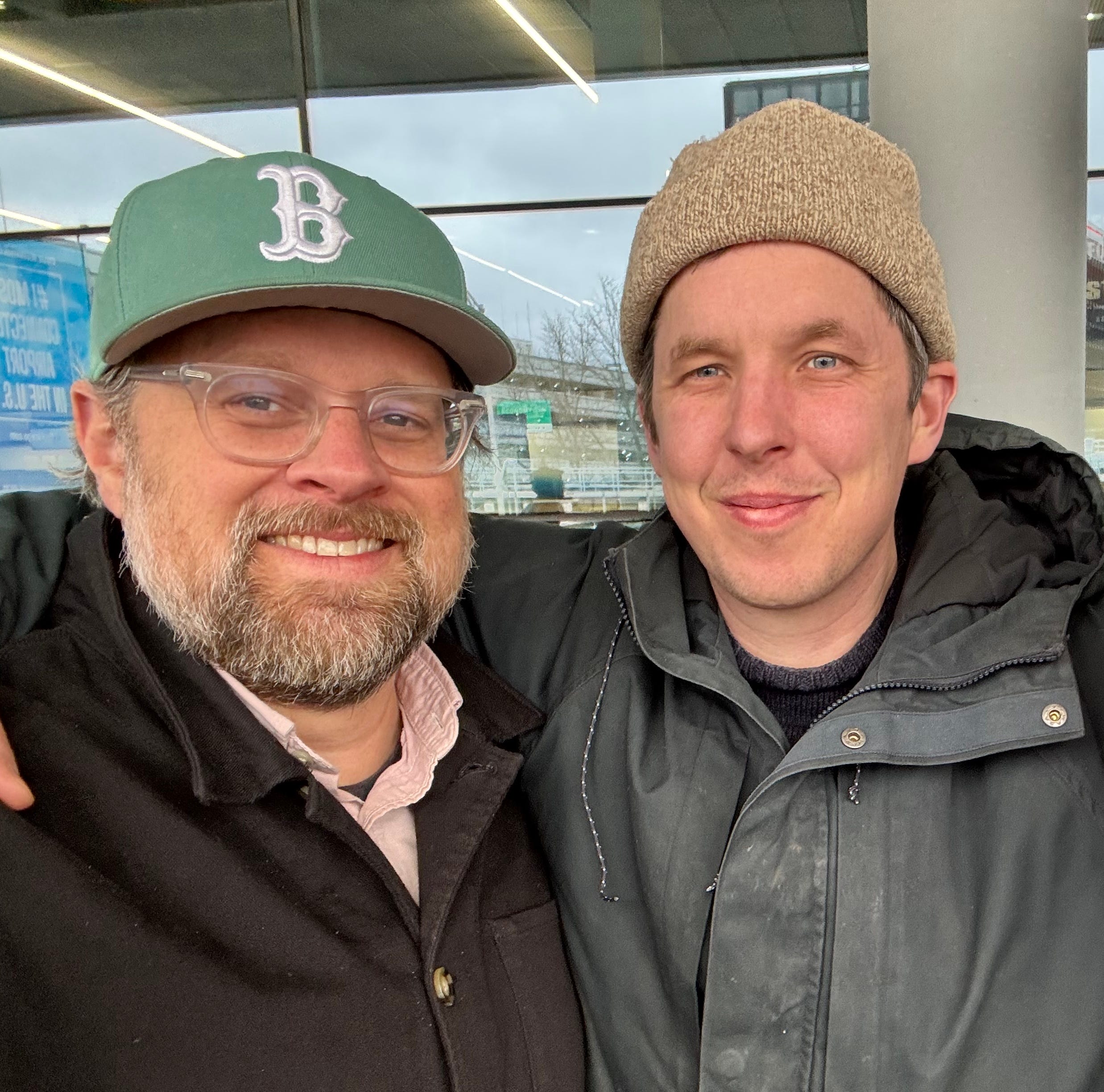
Baker is a member of St John’s. He’s also a master iconographer. He’s also going to be one of the iconographers that adorn our new temple.
Not too long ago, we did an interview with Baker for Come See Something Beautiful. The interview was conducted by an old friend of Baker’s, a seminary student in our parish named John Bell. You can read the entire interview here—Interview with Baker Galloway—and you really, really, really should take the time to read the whole piece because it’s just that good: You’ll learn a lot about iconography and beauty, and you’ll also get to see how a master iconographer like Baker approaches his work.
But here’s one section of the interview that really jumped out at me:
“I'll start from my early 20s, because it took me awhile to find a creative voice as an artist. It wasn't until after I became Orthodox that I sort of found that voice in art making. Looking back on it, I think the common thread running through the work of my 20s was exploring subjects of vulnerability…In a sense, that early work was a precursor to making icons. I was positioned as an artist making something, and I wanted the viewer to feel, as they looked at the piece, that there was something private and hidden that the artist knew and cared about. There was this intimacy I wanted to communicate - a kind of communion or connection…There wasn't really a divine element to it — it was human-to-human. The artwork transcended the physical medium to connect people to people, but there wasn't anything particularly spiritual about it.
“Eventually, as I made my way into learning iconography…it became clear that I could bring my own voice to the work as an iconographer. There would be a through line. In this case, it was that making a piece of art was no longer me as the artist saying to the viewer, "I see these aspects of your life, and I'm connecting with you about these experiences." Instead, I was confessing or witnessing to the viewer of these icons that the person depicted, whether Christ or a saint, sees every bit of your life, loves you, prays for you, is with you in your sorrows and your joys. I'm simply doing my best to help make an introduction through the icon to the depicted person, and to give that intimacy of connection to whomever becomes the viewer. But it's not with me as the iconographer, it's with the depicted person.”
When Baker talks about using art to make a connection with other people—reflecting their feelings, their concerns, their needs—he is describing what happens in modern worship music. A lot of that music is powerful and inspiring, but it’s also just about entirely focused on us.
Which may seem like an exaggeration, but look at it this way: Here’s a link to the lyrics for the super popular worship song “Oceans”.
SongGenius: Oceans by Hillsong UNITED
Got it?
OK, the lyrics we’re looking at include a lot of repetition, but, basically, there are 25 lines in the song. Out of those 25 lines, there are only 4 in which a personal pronoun (I/me/my/mine) does not appear—and of those 4 lines, two mention oceans rising, one refers to the “great unknown”, and one focuses on how “grace abounds in deepest waters”.
So, as Baker notes, while there’s this powerful intimacy in the song, that connection is “human-to-human”; there’s not “really a divine element to it”.
In other words, “Oceans” is, ultimately, about us; it’s only tangentially about The Father, Son, and Holy Spirit.
But if you’re reading this, and you’re tired of just singing in the Great American Echo Chamber of Self, you really ought to look into Holy Orthodoxy.
That doesn’t mean you give up all human connections—as we proclaim in that other quotation from Psalm 150 at the top of this section, we praise the Most Holy Trinity “in His saints”—or, as Baker puts it in his interview (and you really ought to read the whole thing): we are seen in every bit of our lives; we are loved; we are being prayed for in all of our sorrows and all of our joys.
St John’s in Cedar Park, Texas, is a great place to experience all that, but if joining us in the Lone Star State is not a possibility, we’ve got all sorts of other ways that you can support us.
Join us in offering the Akathist for a New Temple every week (PDF/video); restack this post or take out a Paid Subscription; pick up some of our CSSB merchandise; commission an image of a beloved pet for the Calming Room of our new temple; make a donation to our Building Fund.
And since we just can’t get enough of our incredible choir, we’ll sign off with them singing some of the music from our Divine Liturgy.