

Weekend Update 5/8
Yep, that’s Peter and Dennis and Jack getting all wild out on the highway.
And, in case you missed it, wild is a Thing right now, here in Orthodox Land.
Martin Shaw has a book out called Liturgies of The Wild.

Paul Kingsnorth is finishing up a volume entitled The Book of Wild Saints.

Those two guys are two of the most popular figures in popular Orthodoxy, and here at St John's, even though we've talked a great deal about being green, all that hype around wildness can make us suburb-dwelling, minivan driving, parish-attending regular folks look—well, kinda tame.
But the truth is we’re just as wild as any forest ascetic; we’re every bit as rugged as all those sea foam saints.
Case in point.
The Epitaphios
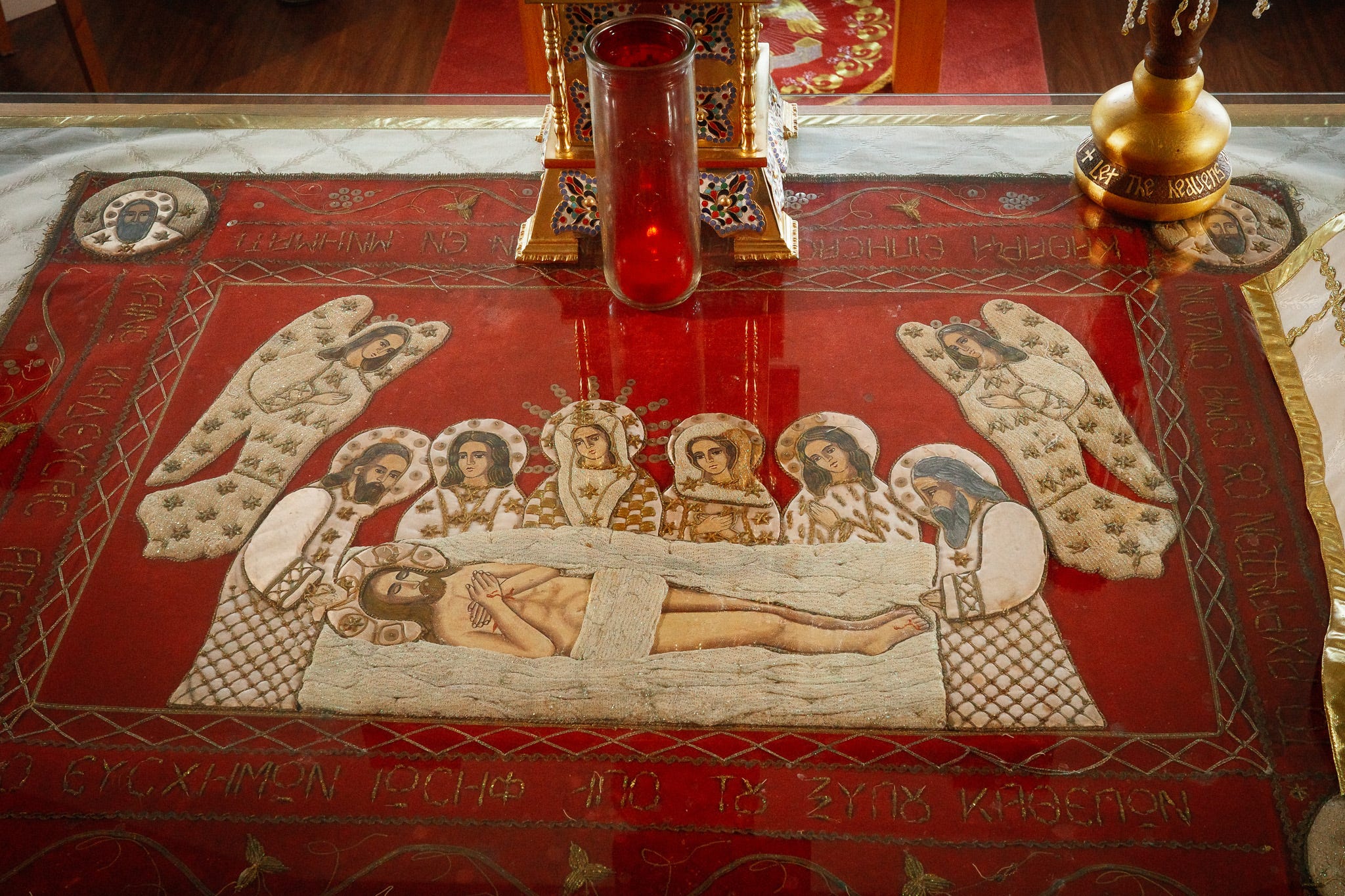
That’s a photo of what our Holy Table looks like at Pascha and throughout the fifty days from Easter to Pentecost.
The cloth icon under the glass covering is called an epitaphios. Like most of the other liturgical terms we use here in Orthodox Land, that word is Greek. It literally means “upon the tomb”, and the image depicts the Mother of God and St John the Apostle and St Joseph of Arimathea and the Myrrh Bearing Women preparing the Body of our Lord and Master for burial as the Holy Angels look on.
The epitaphios is used at several points during the services of Holy Week, but between Pascha and The Feast of the Ascension, it rests on the Holy Table. After we celebrate the Ascension of Christ Jesus, the epitaphios is placed in a glass covered frame, and it’s hung over the door between the narthex and the nave.
The Scorpiones
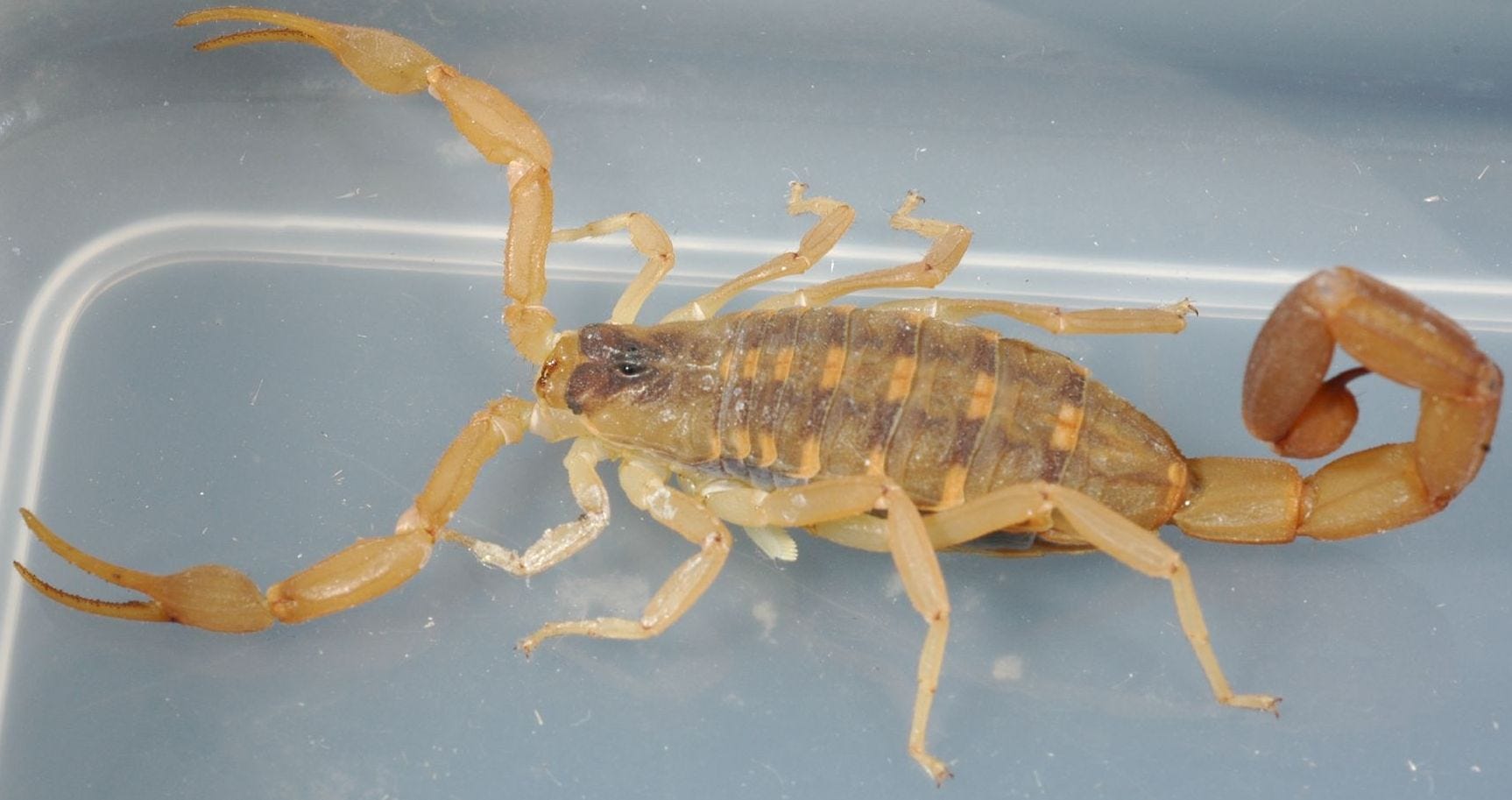
I know: you were expecting scorpiones to be a Greek word, but it’s Latin, and it refers to that Texas arachnid with eight legs and a sting in its tail.
So, a while ago—back when Father Andrew was still Father Deacon Andrew—it was just about this same time of year. We were a week or so on the other side of Pascha, and the ephitahphios was on the Holy Table under the glass.
But there was something else under the glass as well.
I think Then Father Deacon/Now Father Andrew saw it first.
“Uh…Father…” he whispered.
Then one of the altar servers saw it. His eyes got really big. He stretched out his hand and pointed at the Holy Table, and then he quickly put his hand over his mouth, as if to stifle a scream (he was a pretty dramatic kid).
But Then Altar Server/Now Reader/Soon To Be Deacon Dimitri Zozuyla was intrigued. He took a step towards the Holy Table and said, “Hey, it’s a scorpion!”
And, sure enough, it was. Apparently, it had been hibernating somewhere in the folds of the epitaphios all through the Holy Week Services and Pascha, and it was just now waking up and crawling around under the glass.
It was about the size of one of those big paper clips (remember: This is Texas), but Then Father Deacon/Now Father Andrew and Then Altar Server/Now Reader/Soon To Be Deacon Dimitri started tapping on the glass, and they got it off of the Holy Table and into an old metal coffee can in which we still keep ashes from the censer.
After the Divine Liturgy had ended, Then/Altar Server/Now Reader/Soon To Be Deacon Dimitri remarked, “Father Aidan, you didn’t look scared at all…
Then/ Father Deacon/Now Father Andrew laughed.
“Oh,” he said. “I guess you don’t know about Father Aidan’s special relationship with scorpions.”
The Zeon
And so now we’re back to Greek.
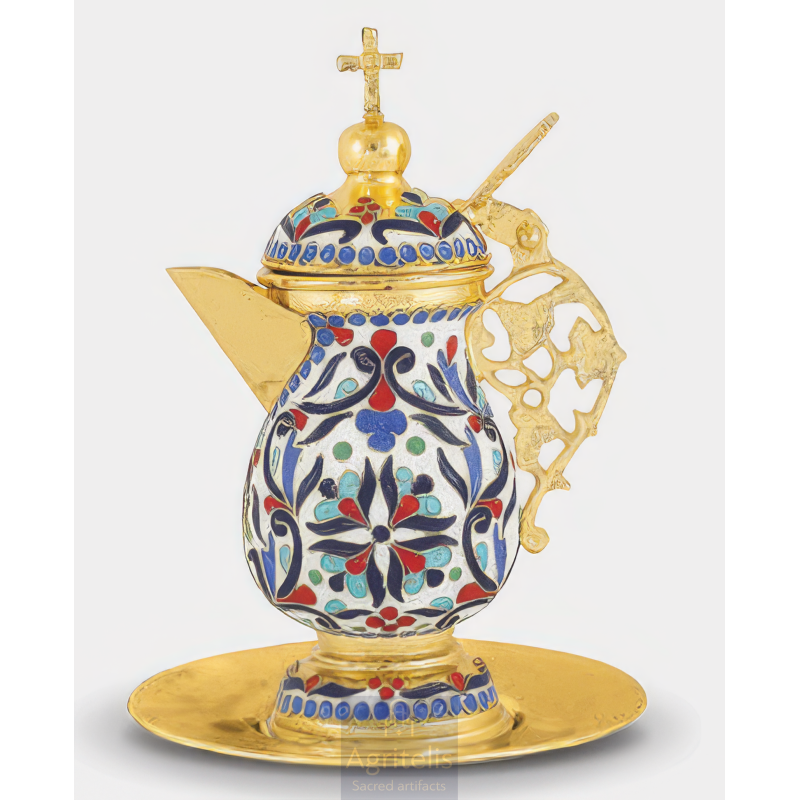
Zeon means “boiling” or “fervent”, and it refers to the hot water that is poured into the chalice just after the consecrated bread has also been placed in it. It is a liturgical action that symbolizes—among other things—the water that flowed from the wound in the side of our crucified Lord and Master and the quickening descent of the Spirit upon the Church.
I say, among other things, because not long after I was ordained to the priesthood, I was serving a weekday festal Liturgy at Holy Cross Greek Orthodox Church in Wichita Falls, Texas.
Wichita Falls is just on the edge of the Panhandle, and, in that part of the country, the water just often tastes bad. So, when it came time to partake of the chalice, I noticed that the water I had poured into it had a particularly bitter twang to it.
At that time, most of the folks in that community were elderly Greek immigrants; they only received communion a few times a year. So, I was the only one to partake at that Divine Liturgy, and, for a weekday feast, there wasn’t anything unusual about that.
After the service, I went ahead and consumed the rest of the chalice. But then, as I was cleaning up The Holy Place, I opened the big round hot-pot that we used to boil water for the zeon, and, floating in the left-over water, was a scorpion as big as a smart phone.
(Remember: This was in West Texas).
Aqua de Alacran.
And that, buckaroos, is Spanish.
It means scorpion water.
So, even though I live in a subdivision and eat fast food and watch re-runs of Law and Order, I’m also a Mark 16.18 Kind of Guy: “…if they drink anything deadly, it will by no means hurt them…”
How’s that for wild?
So, if you’re looking for a community that’s not only wild, but also wooly (Once again, all together. Remember: This is Texas), you just can’t do better than our parish.
If re-locating is not an easy option, we’ve got other ways you can support us.
You can join us in offering The Akathist for a New Temple each week (PDF/video). You can upgrade your subscription to Paid. You can pick up a CSSB hoodie or commission an image of a beloved pet for the Calming Room of our new temple or you can make a donation directly to our Building Fund.
Martin and Paul talk a lot about British and Irish saints, which is entirely appropriate, but we’ve got our own brand of happy holiness right here in the Lone Star State, and so we’ll sign off with an (equally appropriate) tune from Mister Charlie Daniels.
There's a lot to think on with those scorpion encounters.