

YBH
The acronym at the top of this post is the invention of the great Anglican writer, Martin Thornton.
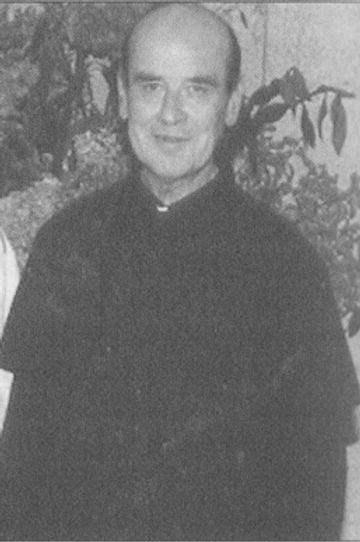
During the previous century, Thornton wrote a lot of really wise and really helpful things about pastoral ministry and the work of spiritual direction. But in one of his books—I forget which—he admitted that when he was reading any author who was in the habit of holding forth on all the important things that need to happen in parish work, he would frequently find himself writing that acronym in the margin: YBH—Yes, But How?
And looking back over the posts of the past few weeks, I realized that if the Cyber-Spirit of Martin Thornton were to visit this Substack, I would be seeing YBH all throughout the margins. Because even though we’ve been talking about some of the biggest challenges Orthodox communities face—children in the Divine Liturgy and Church School and how all that fits together—I’ve yet to address any of the practical issues that make those challenges so, well, challenging.
Now at several points I’ve alluded to what we do at St John’s, but I’ve not gone into any great detail. You might think that’s because I’m such a modest and self-effacing guy, but five minutes of conversation with the folks who put up with me on a regular basis will dispel that illusion. No, I’ve not yet shared any specifics about what we do in our parish because I believe there are some important principles that should anchor that conversation. And what I want to do in this post is briefly outline those principles.
So, here we go.
Principle #1: We don’t do franchises.
I served as a United Methodist pastor in the 1980s and 1990s, and, during those decades, there were successful Protestant congregations that everyone admired and that everyone wanted to emulate. There was Saddleback in California and Willow Creek in Illinois. Later on, there was Mars Hill in the state of Washington. There were even denominational versions of that dynamic, because lots of United Methodists admired Windsor Village in Houston and Church of the Resurrection in Kansas City.
Each of those congregations was led by a Big Personality, and a lot of those congregations ended up blowing up after the Big Personality crashed and burned. Nevertheless, when things were going well, each of those congregations also hosted conferences and seminars and workshops. And the clear purpose of those conferences and seminars and workshops was to help other communities become Just Like Them.
And we’ve got that same franchise mentality at work in American Orthodoxy. I don’t know of any communities or any clergymen that self-consciously set themselves up as models for others, but the vibe is still present: Folks want the music in their services back home to be just like the music at the monastery to which they go on pilgrimage; the priest who makes all those videos mentions that his parish has a group of women who are specifically tasked with helping young women find husbands, and, before you know it, your parish council is talking about starting the same kind of group.
Of course, there’s nothing at all wrong with sharing best practices or good ideas, but we are the Church. That means our criteria for adopting a new approach is not “Father (fill in the name of a very online clergyman) is doing this,” or “The sisters at (fill in the name of a popular monastery) believe this is important”. We start new projects if that’s what the Father, Son, and Holy Spirit want us to do.
So, later this week, when you are reading about what we do at St John’s when it comes to Church School and children in the Divine Liturgy, remember: That’s what the Most Holy Trinity wants us to do. The Father, Son, and Holy Spirit may have very different plans for your community.
Principle #2: We put people over programs.
If you’ve spent any time at all in Protestant World, you know that it is full of organizations and companies that produce programming for congregations: Church School curriculum; Vacation Bible School programs; Activities and Action Plans for Teens; Adult Education Resources. A lot of this material is connected with denominational agencies, but a lot of it is also generated by independent outfits.
And the whole idea is that anyone can open the box or click on the link and find all they need to lead an event or host a group. I know that sounds like a caricature, but it’s really not. It’s just programming stripped down to its most basic functions: you find a volunteer; you provide them with the necessary materials, and you call it Church School (or Youth Group or Bible Study).
Unfortunately, we Orthodox are starting to use the same approach. We don’t have the large, legacy publishing houses and curriculum mills that you still find in Protestant World, but we’re beginning to see smaller businesses modeled on the premise that education is a kit that you unpack and formation is a video that you show at a watch party.
Now, it’s not that we’re somehow opposed to programming—far from it. We’re just convinced that who leads the program is every bit as important as the content of the program. So, when it comes to Church School, we use a curriculum that puts as much emphasis on the spiritual development of the teacher as the spiritual development of the child. And, yes, that curriculum requires the teachers to participate in a great deal of training, and—absolutely—that training is expensive.
So, what if you are in a parish where there’s just no money and folks who are willing to teach—let alone go through all kinds of training—are few and far between?
Well, this is the point in the post where I refer you back to Principle #1. Perhaps this isn’t what the Father, Son, and Holy Spirit want you to do.
But let me quickly say that doesn’t mean you have to fall back on the plug and play programming. It just means we need to move quickly on to the next principle.
Principle #3: We pray. We pray a lot.
If we will fully invest ourselves in the cycle of the Church’s Divine Services, what we will bring into existence—or, rather, what we will tap into—is an environment of grace. That’s just another way of saying that we will actually start living in the Kingdom, and, in the Kingdom, in the Church, we always get everything we need.
So, this afternoon, I’m going to be at the parish around 4:45 pm, serving Vespers. Tomorrow morning, I’m going to be up at the parish at 4 am for Orthros. And while I’m offering those services, there won’t be any specific prayers for our Church School; however, I’m sure some of the needs of that ministry and the folks who staff it and the children who participate in it will come to my mind. And what I will do at that point is simply place each of those needs upon the altar of my heart—and if I happen to be close to the Holy Table at that moment, I will probably reverence it, to make that spiritual connection that much more real.
And, actually, even though I’ve been kind of hard on our Protestant brothers and sisters in this long post, it was those good folks who first taught me how to do that. Here’s a hymn I used to sing just about every Sunday and Wednesday night:
Of course, we never once sounded that good on those evenings out in East Texas, but through that hymn I learned that I can leave everything on the altar with complete confidence because 1) it’s not like I’m informing the Most Holy Trinity about something which isn’t already fully and completely known in that Divine Community; and 2) the Father, Son, and Holy Spirit are indescribably smarter and wiser than I am; and 3) in the love of the Kingdom, all those needs on the altar have already been met. My job is to patiently wait for the answers.
Speaking of waiting, now that I’ve sketched out those three anchoring principles, I’ll go ahead and describe, in our next posts, what we do for Church School and what we do for children during the Divine Liturgy.
But while you’re waiting for those posts to pop (and where else, but on Substack, would you get to write a line like that?), why not offer The Akathist for a New Temple (Akathist: PDF/video)? You might also consider becoming a paid subscriber to this Substack or even make a direct contribution to our temple project. If what we are doing at St John’s is worth your support, we will be grateful for that support.