

Minds II
It’s good to be out here on the road.

We’ve been traveling since Pascha. Our destination is the Great Feast of Pentecost. And the reason we’ve been logging all these miles is because we want you—that’s right—you to become a certified LLH.
That’s a Liturgical Long Hauler.
LLH is a concept that we picked up from St John Climacus. In his classic The Ladder of Divine Ascent, he writes that “what is obtained as the result of long and persistent prayer remains.” And since we want to build a temple that’s going to be around 600 years from now, we figured we need to equip a lot of folks for that work of “long and persistent prayer”.
So, we’ve been sharing Persistence Pointers on just about every day of our road trip. In our last post, we talked about how, if you’re going to pray with persistence, you have to use your mind. But that’s a pretty big topic, so we’re going to be working on that same pointer during today’s discussion.
The last time we were together, we talked about how we have to clear all the external stuff out of our minds: that means we have to disconnect from most media and start the lengthy process of discarding all the images, memes, music, commercial jingles, tag lines, talking points, movie clips, sports stats, historical references, political trivia, and killer jokes that we have amassed over the years.
But once that epic cleaning out process is complete, we still have to contend with all the self-generated, internal stuff: grudges, worries, fantasies, projections, memories, obsessions, and fears. So, what are we supposed to do with all that?
The Holy Fathers teach that we can do one of two things with our thoughts: we can offer them up, or we can just ignore them.
The thoughts we should offer to the Most Holy Trinity are the resentment that we carry against our sister-in-law for the way she treated our children at Thanksgiving last year and the anxiety we have about whether our spouse will ever find the courage he needs to stand up for himself at work.
When those sorts of thoughts appear in our minds, we should simply place them on the altar of our heart and give them to the Father, Son, and Holy Spirit. That may sound completely unrealistic, and it does require a good deal of effort, but it works, and our patron saint and our guardian angel and the Most Holy Theotokos always stand ready to help us with those offerings.
The thoughts we should ignore are the daydreams we have about exactly what we will do when we win the lottery and the catastrophizing we do about our child’s future when she doesn’t do well on her college entrance exams. According to the Holy Fathers, once we recognize those thought patterns, we just shouldn’t engage with them at all, because they aren’t, finally, real.
But it’s not enough to simply respond to the thoughts that our mind generates. We also have to take charge of that thought-generating process. We have to train our mind to think in a different way, and that starts by providing it with new thoughts.
So, where do we get these new thoughts?
According to the Holy Fathers, that’s one of the main uses of Holy Scripture.
Which, when you think about it for a moment, is just all kinds of ironic.
Because we 21st century Christians use the Bible for all sorts of things: as a scientific treatise, as a blueprint for political action, as a source of moral guidance, as an all-purpose answer book, as a patriarchal text that has to be deconstructed, as a collection of ancient literature that can only be accurately interpreted by specially trained scholars, as an oracular document that can prepare us for the end of the world.
But we hardly ever use the text of Holy Scripture as a replacement for our thoughts, and, not surprisingly, we are stressed, agitated, distracted, and just generally, mentally, miserable.
What the Fathers encourage us to do is very simple: Find a short passage of Holy Scripture; commit it to memory; repeat it throughout the day and when you wake up in the night.
And, right away, some folks are going to insist that’s just a religious way of being obsessive, and, it most certainly can be, but if we have taken the time to do the preliminary work—cleaning the junk out of our minds and learning how to either offer up or ignore our thoughts—the result will not be compulsive, but peaceful.
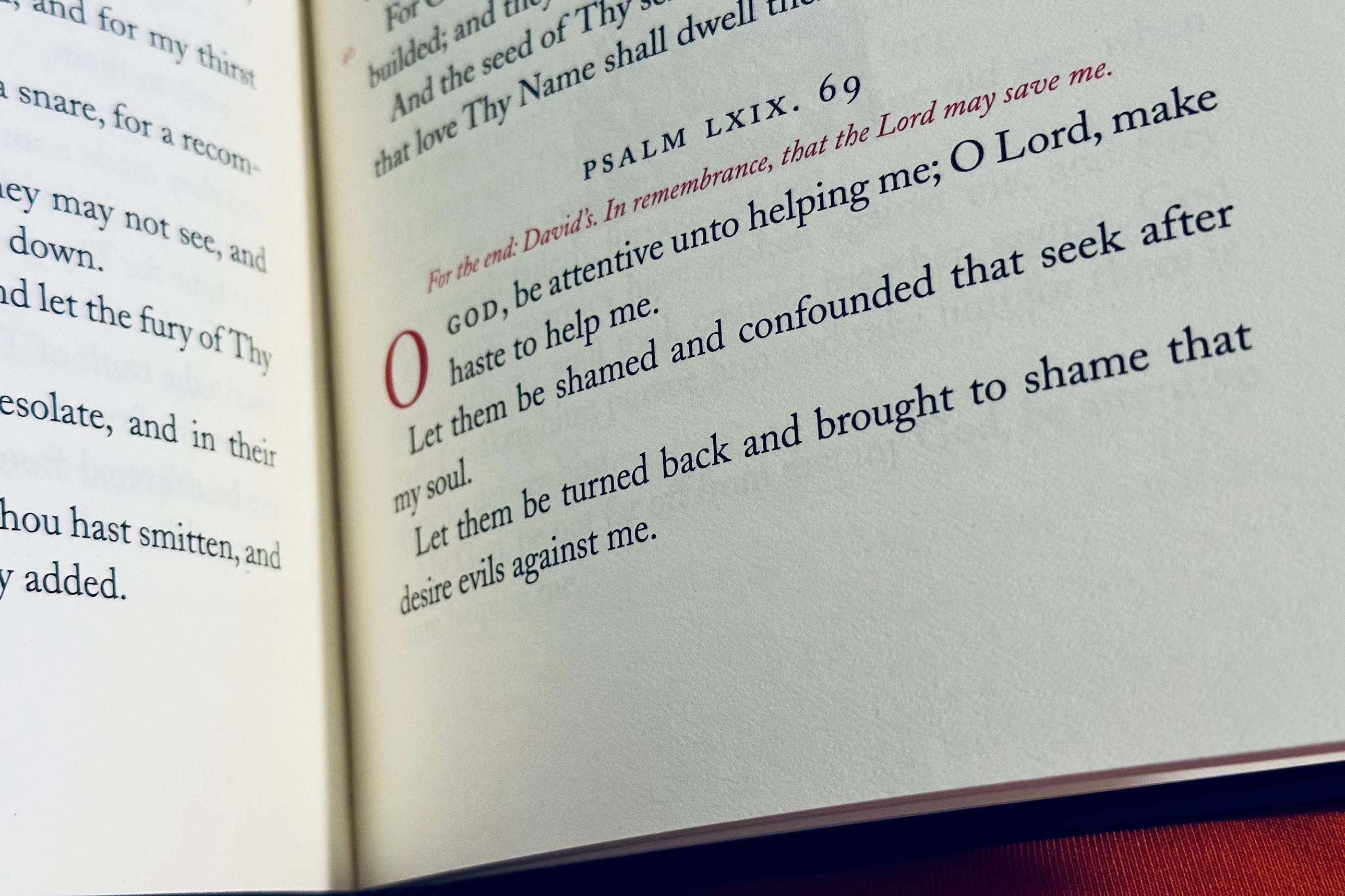
For example, many of the Holy Fathers recommend using the opening verse of Psalm 69: “O God, make speed to save me; O Lord, make haste to help me.” If we get that verse front and center in our minds—and even say it quietly out loud when we are alone—then, eventually, it will become the center of our attention. It will become the main focus of our mind.
And, again, if we’ve done the preliminary work, that centering or focusing process doesn’t take nearly as long as folks think—in fact, it happens fairly quickly.
Now this is the point in the conversation where folks always ask about the Jesus Prayer. The Jesus Prayer is a combination of various texts of Holy Scripture, and, due to a variety of different circumstances—involving, among others, T.S. Eliot and J.D. Salinger—the prayer has become well-known.
However, the practice of memorizing a short passage of Holy Scripture and using it to concentrate the mind is actually the older practice, and for a lot of people, it might actually be the best practice to take up, since the Jesus Prayer is now becoming just another part of our broader culture (as evidenced by the fact that I just did a quick Google search that instantly brought up five Jesus Prayer apps—and, no, we’re not going to share those links).
So, it’s going to be best to stick to the oldest ways.
During this post, we talked about offering our thoughts on the altar of our heart. The heart is going to be what we’ll focus on with our next Persistence Pointer, but, right now, we want to ask you to remember to join with us in offering the Akathist for a New Temple on a regular basis (PDF/video).
You can also support our project by bumping your subscription status up to Paid or by checking out our Come See Something Beautiful clothing. And, of course, you can commission an image in the Calming Room of our new temple or make a donation to our Building Fund.
And since we’re in the final stages of our road trip, we’ve just got to listen to the great Edwin ‘C’mon, feet don’t fail me now’ Starr burning through Twenty-Five Miles (“ten..nine…eight..”)
Oh good gravy. I really needed this. And the prior one. Ugh. And Lord… have mercy.