

“Why Don’t You Just Have Extra Services?”
During our first twelve months here on the ‘stack, folks have asked us a lot of questions. As we just celebrated our one-year anniversary, we thought we probably ought to get around to answering some of those questions.
And that’s probably the question that we’ve heard the most: If you’re out of room, why not just add additional services?
Of course, in American Christianity, additional services are a sign of success: it means you’ve outgrown your current space; it means you’re attracting more people. In fact, a congregation that does not have multiple services is regarded as static and stuck.

But there’s also a flip side to that dynamic: offering additional services means that each service can be designed with a specific target audience in mind. So, the early service is for folks who prefer a more traditional order of worship; the main service is for people who like contemporary music and who are comfortable with lots of tech; many congregations now also offer a more subdued, contemplative service—and then there are services for youth and children, as well.
The whole idea is that lots of choices in terms of style and lots of options when it comes to scheduling are going to make it possible to appeal to lots of different people.
But that’s not how things work in Orthodox Land.
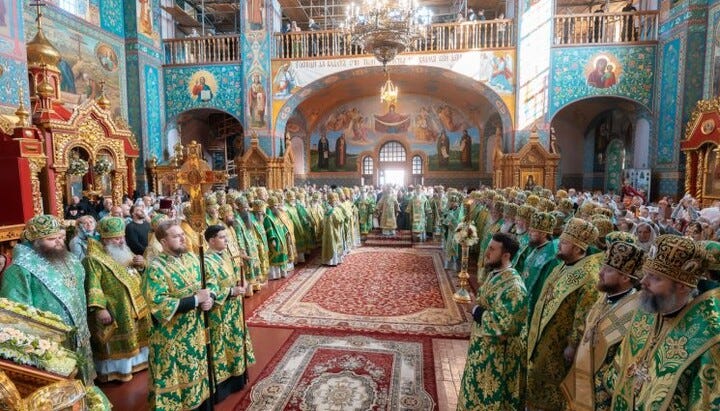
We just have one main service: The Divine Liturgy. Historically, our tradition has been that everyone attends that service together—and to support that tradition, the canons of the Church forbid a priest from serving more than one Divine Liturgy per day.
Which sounds odd until you realize the value we Orthodox place on unity.
Because, for us, unity starts with the fact that we all gather together in one place at one time and offer the same service before the same altar. There are a lot of other dimensions to our unity—the beliefs we proclaim, the calendar we keep, the teachings by which we abide, the structures by which we are organized—but it all starts with showing up alongside our sisters and our brothers for The Divine Liturgy.
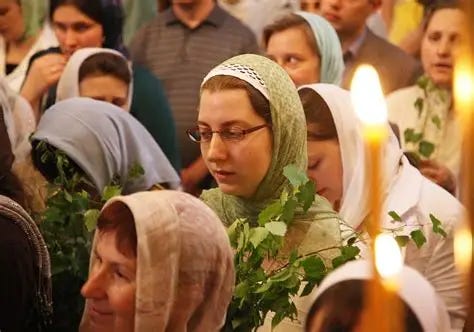
So, in Holy Orthodoxy, unity is not an abstraction; at its most basic level, it’s about the person standing next to us in the services.
Nevertheless, human nature being what it is, you really shouldn’t be surprised to learn that a good many Orthodox communities have found a way to—well, let’s just say they are massaging that concrete take on unity into something that’s a lot more…theoretical.
That’s because there are a number of Orthodox parishes which now have two liturgies on a Sunday morning. And, strictly speaking, they’re not doing anything uncanonical: they have multiple priests on staff, so each priest still offers just one liturgy, and all of these communities have obtained episcopal permission to do what they are doing. In other words, their bishops have blessed the arrangement because the folks in these particular parishes believe that they just can’t fit everyone into their current facilities.
But just because a bad idea appears to be a common-sense solution doesn’t mean it’s not also a bad idea.
And more than one Divine Liturgy on a Sunday morning is a bad idea.
Now, to the credit of our hierarchs, none of them have blessed this sort of arrangement as a permanent solution. It’s supposed to be a temporary measure. However, as anyone in American Christianity will tell you, once you have started a new service, it’s very, very difficult to later shut it down.
That’s because—surprise!—the folks who attend that new service begin to regard themselves as a congregation within the congregation, as a community within the community. They will start to form a separate identity from the larger group; they will see themselves as “the folks who attend the Early Morning Liturgy” or “the people who get to go to brunch early”. And even if they were told ahead of time that the entire set-up is only going to last until the new building is complete, once it’s time to discontinue that additional service, there will be resistance, if not outright opposition.
But there’s more to this than just challenging social dynamics. Because adding an additional Divine Liturgy also disrupts the Typicon of the Church.
The Typicon is the schedule of the Divine Services.

That schedule has basically been the same since the tenth century. The schedule is handled differently in Byzantine and Slavic Orthodoxy, but, in Byzantine communities, the Divine Liturgy is always preceded by the Service of Orthros.
In the West, Orthros is known as Matins; it’s the daily morning service. It’s also the service in which the bulk of the Psalter is read and most of the hymnography is sung. That means Orthros is where we are trained in the Holy Scriptures (through the Psalter) and where we are trained in the interpretation of the Holy Scriptures (through the hymnography).
Unfortunately, as we’ve pointed out before, most Orthodox communities only offer about fifty minutes of what should be a two-hour service. So, in a great many parishes, Orthros is now more of an opening act for the Divine Liturgy than a service that has an identity of its own.
But when folks decide to offer two Divine Liturgies each Sunday morning, Orthros disappears completely. There is simply not time to serve Orthros along with an additional Liturgy, so communities simply stop offering Orthros altogether—and, again, it’s always ‘temporary’; people always insist that, at some point, everything is going to go back to ‘way it should be’, but that hasn’t yet happened in any of the parishes that offer two Divine Liturgies on Sunday morning.
Of course, I could be mistaken about that.
I mean, if you know of an Orthodox community that has successfully offered an additional Divine Liturgy on Sunday morning for a limited period of time, and then returned to the traditional schedule of Orthros and Liturgy, please let us know.
While we’re waiting on that update, why not join us in offering The Akathist for a New Temple (video)? You can also swap out your regular subscription for one that is Paid, pick up a Come See Something Beautiful T shirt, commission an image of a departed pet for the Calming Room of our new temple, or make a direct donation to our Building Fund.
And, not surprisingly, we’re still waiting…
But we do have a solution to all this, and we’ll share it with you in an upcoming post. In anticipation of that, we’ll leave you with an appropriate tune (once, again) from The Fab Four.