

Children in Church
My last post was about Church School and the Catechesis of the Good Shepherd. We offer that program during Orthros, the service before the Divine Liturgy. What we’re going to focus on in this post is how we support and nurture children during the Liturgy.
Of course, not all of our children participate in Church School. Some are too young; some live too far away (we have folks who drive as much as two hours to get to our parish); our youth have their classes after the Divine Liturgy, following Fellowship Hour (they like to sleep in).
But even if they aren’t able to be in Church School, there is still a sequence, a pattern, a dance that unfolds when children arrive in our temple. The first space they enter is the narthex. In our current facility, that area is primarily practical; there are a few icons on the walls, but it’s mainly a space where families orient themselves: they hang up jackets; they put up diaper bags; they make sure all shoes are tied and each head scarf is on straight.
But in our new temple, all that preparatory work will take place in a room that is also adorned by iconography:
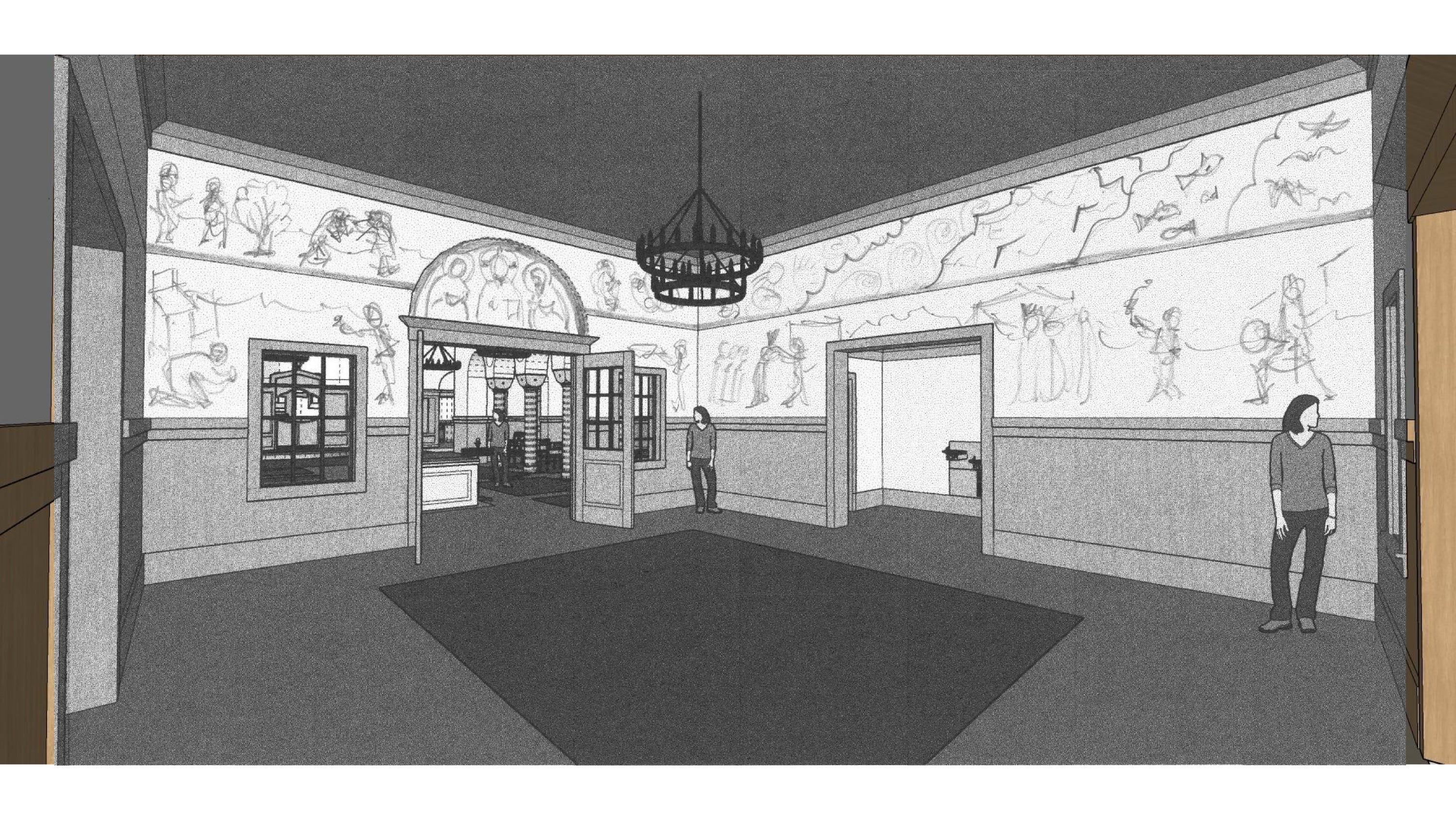
Down the road, we’ll dedicate several posts to that space and that iconography, but what we’ll say right now is that, in our new narthex, even the work of getting ready to enter the temple will take place amidst the beauty of the Kingdom.
So, back to the present: the family walks into the nave; they reverence the icon that’s on display; they light their candles—and depending on the ages of the children involved, that’s going to require a lot of lifting and lowering and a great deal of guidance and supervision—and then the family heads for their normal spot.
Notice I said ‘spot’, not ‘pew’ or ‘seat’.
That’s because we do not have any fixed seating (see: Standing Church).
And what that means on a practical level is that families are able to configure themselves in just about an infinite variety of ways. Some clump. Some go vertical. Some break up into separate units and situate themselves throughout the nave.
Exactly how that happens depends on the number of folks in the nave (and on Sunday mornings, we are always crowded), but not having fixed seating means that families can arrange themselves in a way that works for them—as opposed to the one-size-fits-all approach that requires everyone-to-sit-next-to-one-another-and-not-move.
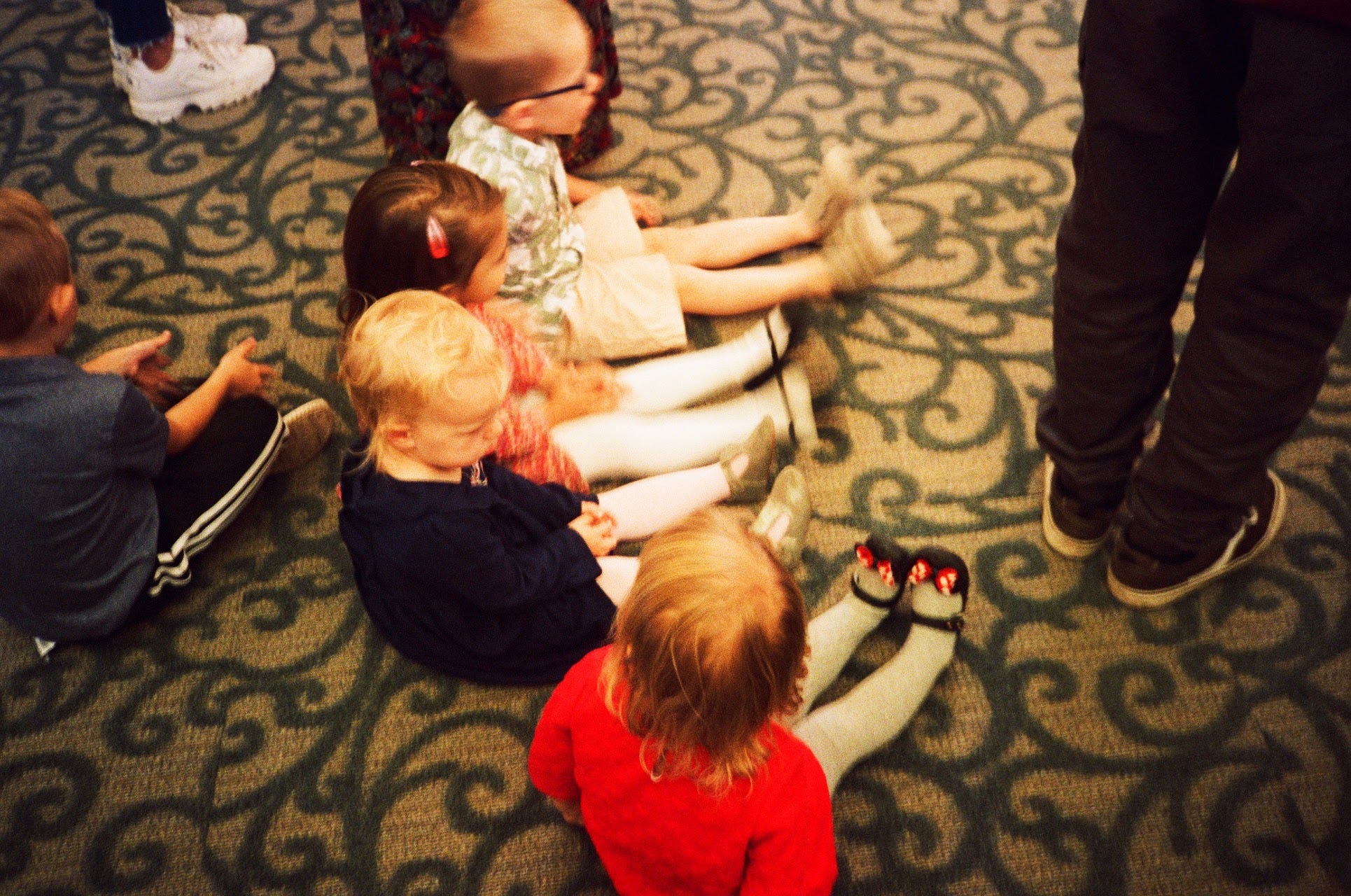
That kind of freedom can be really disorienting at first, but it doesn’t take too long for folks to get the hang of it. And when they realize that it’s possible to go in and out of the nave without crawling over everyone who’s between you and the end of the pew or the row of chairs (“Excuse me/I’m sorry/Excuse me again/Yes, it’s us again/Excuse me/Oh, I’ll pay to have that cleaned/I’m sorry/Excuse me”), they’re sold.
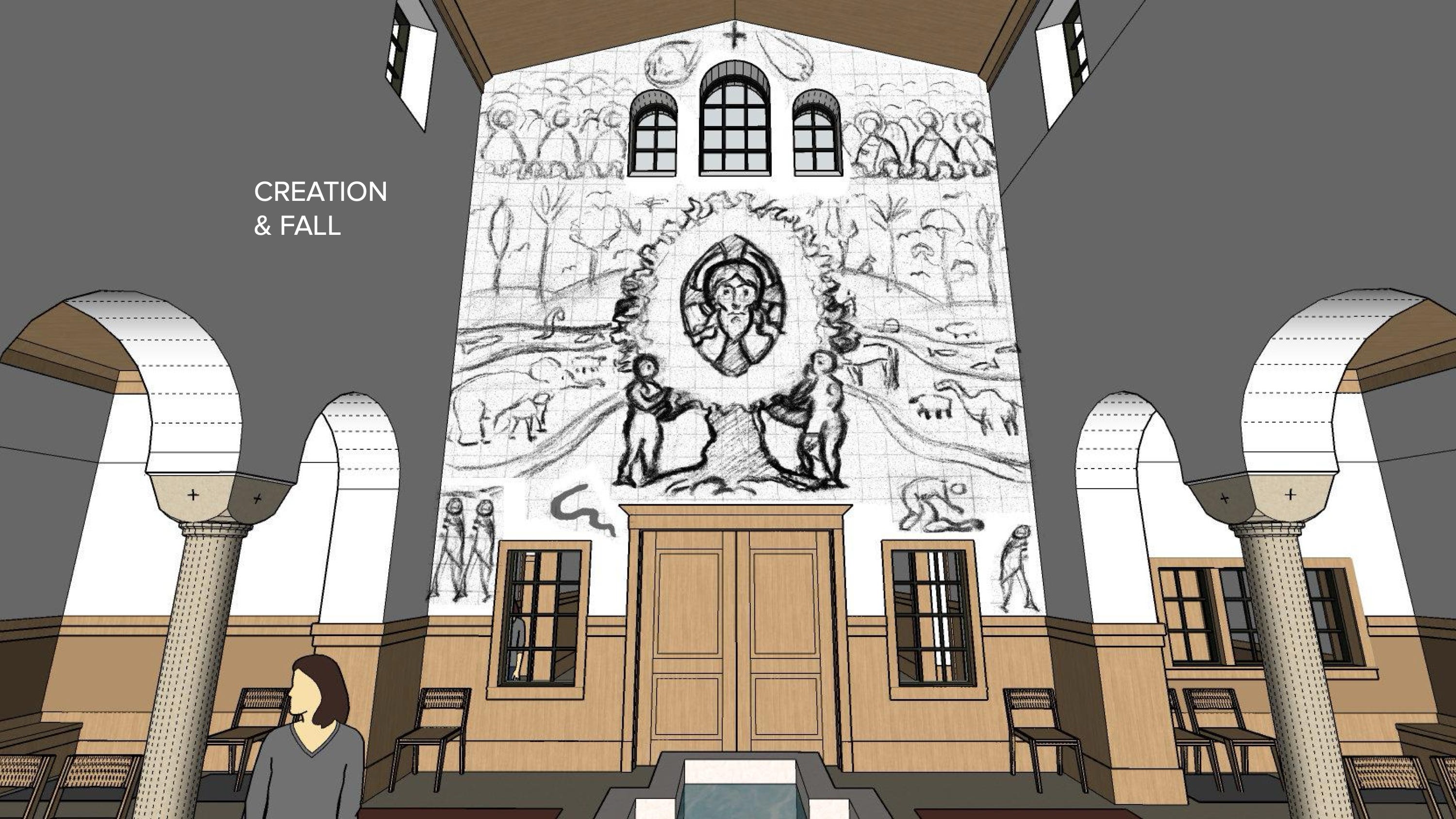
And, sure, there’s a lot of movement in our nave. But that’s just part of the Dance: Moms need to nurse infants; dads need to take toddlers out for a break; children have to go to the bathroom. We have a Calming Room in our current building that has a nice selection of children’s books with spiritual themes. Our new temple is going to have a similar room, but like the narthex we have planned, the new calming room will also be adorned with iconography.
Of course, there are times when it is liturgically appropriate to move in and out of the nave, and there are times when it is not. So, we have ushers in the narthex who provide folks with that kind of guidance. But it doesn’t take long for people to pick up on the fact that there is an overall rhythm to the service, and most folks just figure out what works for their children at their particular ages and stages, and they go with that liturgical ebb and flow.
However, the sound of that ebb can be a bit much; the clamor of that flow can be pretty loud. When you’ve got 300 plus folks in a large space, and when about 40% of those 300 plus folks are preschool or elementary age children, there’s just going to be some noise. We are blessed with an absolutely magnificent choir, and all of our folks sing along, but sometimes there’s an infant who wants to solo; sometimes there are two siblings who want to contribute a contrapuntal duet.
When that sort of thing happens, folks will often ask me, “But what can we do about that?”
And this is my constant answer: “Keep praying.”
For sure, I realize that there are many people who believe that the Divine Liturgy should be offered under concert hall conditions and who insist that folks should behave as they would in a museum. And I think that it is important to teach reverence and respect, especially when our culture is so lacking in those qualities.
But I also know this: In just the past month, we’ve adored the God Who was born as a Child in a crowded stable-cave, and Who, as a Man, was baptized in a river with a whole lot of other people. That’s what Incarnation means, and so if, during the Liturgy which communicates that Incarnation to us, our worship gets messy or a bit chaotic, we can also offer that expression of our humanity to our Incarnate Lord and Master, and He will transform it and us and this entire world.
If that’s the kind of service you would like to attend, help us build the temple in which it is going to take place. Join with us as we offer the Akathist for a New Temple (Akathist: PDF/video). Subscribe to this Substack, or, even better, make a direct donation to our project.
I love seeing the dance and calling it that, rather than calling it chaos or disruption…I once had a pastor say that fussy children and good intentions had one thing in common: they should both be “carried out” immediately. It got some chuckles but also gave me an icky feeling in my gut. The “I am a child in church” write up in the calming room was a balm to that “ick” as is this post:)